Comments about technological history, system fractures, and human resilience from James R. Chiles, the author of Inviting Disaster: Lessons from the Edge of Technology (HarperBusiness 2001; paperback 2002) and The God Machine: From Boomerangs to Black Hawks, the Story of the Helicopter (Random House, 2007, paperback 2008)

Wednesday, May 20, 2026

Inviting Disaster, 25 Years On

 In the small Nebraska town of Lewellen, there's a restaurant and art gallery named The Most Unlikely Place. And it really is a surprising find in such a tiny town. 

I thought of the cafe and its improbable name earlier this month when attending a dinner meeting of the Minnesota Geological Society. I talked with the fellow named Roger sitting next to me, also retired, and we shared stories about our work lives. 

I mentioned I'd been writing nonfiction since 1979, including my book on techno-disasters and close calls. He asked which cases were included in Inviting Disaster and I rattled off a few, ending with the near-destruction of American Airlines Flight 96 in June 1972, a DC-10 jumbo jet saved by the remarkable skill and foresight of the captain, Bryce McCormick. (photo: Ken Haynes collection)

McCormick had anticipated loss of flight controls three months before, when training on the airline's DC-10 flight simulator in Fort Worth. He'd stayed late to train on how to steer the plane with just the throttles. 

Then, when a cargo door blew out over Windsor, Ontario, taking out most of the controls, McCormick was able to nurse the plane to a safe landing in Detroit. 

To my astonishment, Roger said he'd been a passenger on that flight. It was such an unlikely meeting, so coincidental, that it inspired me to gather thoughts about lessons I've drawn from 25 years of lectures, opeds, and interviews that followed the publication of Inviting Disaster. So stay tuned for that!


Wednesday, February 18, 2026

"The Greatest Gift," a column from 1915

Our book club is reading Nicolo Machiavelli's The Prince, and by the time I reached Chapters 22-24 (on leaders and their advisers), this classic column came to mind: 

THE GREATEST GIFT

From The Smart Set, November 1915 

By Owen Hatteras (pseudonym of H.L. Mencken and George J. Nathan)

THE fairies who fly with gifts to the cradles of all new-born babies had had a busy day. There had been so many little newcomers, and from early morn to nightfall they had flitted from home to home, bestowing riches here, beauty there, sins, virtues, graces and failings in a haphazard sort of way. They had paused, too, at sunset, in a tenement basement, and breathed genius into the heart of a tiny boy. Now, it is very tiring to bestow the gift of genius; it requires great effort and that's why the fairies almost never grant it. When they were finished, they were a little weary and cross, and wanted to fly home to their palace of moonbeams. But one cradle remained unvisited. So they hied them to the side of a colicky, squirming infant boy who wailed raucously into the night. The fairies grew angry as they heard him. Reluctantly they shrugged their dainty wings, and flew off without leaving a single gift behind. Only one wavered an instant, glanced pityingly at the ugly child, and called over her shoulder as she hurried to join her sisters:

"I bestow upon you the gift of Gigantic Ignorance, and the gift of Majestic Incapacity."

The years went by.

The boy grew up into a benign-faced, wide-girthed man who looked like a picture of God by Harrison Fisher.

He wrote Books with a Purpose which ran into twentieth and thirtieth editions, and spread his fame into all lands until he had scarcely time to rake in the shekels that came pouring into his coffers.

Newspapers vied with one another for the opportunity to pay thousands for his Uplift Editorials.

He gave utterance, at lectures, to Great Ideas upon suffrage, upon eugenics, upon temperance, upon the social evil and the poor working girl.

Sightseeing buses stopped before his house, and his disciples gazed with reverence upon its sacred portals.

He preached zealously against the Vicious Influence of Continental Literature, and cleared the theaters and book-stores of every vestige thereof.

They called him the Protector of Innocence, the Champion of the Masses, and from far and near adherents flocked unto him.

He went into politics. They made him mayor, they made him governor, they made him president for three terms, almost they made him God.

And as he drove through the streets, while the crowd waved their hats and cheered him wildly and went mad in honor of their Great One, men bowed their heads, and whispered to one another in awe:

"What great, mysterious gift was bestowed at birth upon our Mighty One, to make him thus our King, our Emperor, our Holiest of the Holy?"


Monday, December 22, 2025

THE JACKET: free again on Kindle ... for a few days

Passing along another free-to-download offer of my first novel, THE JACKET. The offer runs on Kindle through Wednesday. 

Now for the promotional stuff: 

Praise for THE JACKET from Nancy Allen, #1 New York Times bestselling author: 

“Deftly plotted and skillfully written, this timely political thriller pits a working class heroine from Appalachia against a cast of crafty villains. The book takes us on a relentless chase in and around DC to snag possession of the ultimate prize: the jacket.”

Praise from Jefferson Flanders, author of An Interlude in Berlin:

"Fans of John Grisham and Stieg Larsson will greatly enjoy The Jacket: Where Secrets Go To Die, a fast-paced Deep State thriller by Jim Chiles that features an engaging cast of characters and an intricate plot." 

The author of THE JACKET is James R. Chiles, author of Inviting Disaster: Lessons from the Edge of Technology (HarperCollins) and The God Machine: from Boomerangs to Black Hawks, The Story of the Helicopter (BantamDell). He has appeared on Coast to Coast AM, All Things Considered, CBS-TV, NHK of Japan, Australian Broadcasting, the National Geographic Channel, and the History Channel. 

Summary: Bodine, a young woman from the Appalachians, has a job delivering dry cleaning to DC's upper crust when a scheme by her boss at the cleaners, Harry Landes, goes off-track and pulls her into high-stakes danger. 

Using highly advanced and undetectable listening gear stolen from the CIA, codenamed PICKET, Landes has been harvesting Washington secrets from DC's ultra-secure locations. He sells the info to a set of uber-wealthy plotters he's dubbed the Three Scrooges. 

Seduced by their status, Landes recently helped the trio kill and discredit a political idealist, Jeremy Coghill. They set Coghill up as having bombed a conservative PAC fundraiser at a DC watering hole. Police draw the obvious conclusion, that Coghill accidentally set off his own bomb from an adjacent room, prematurely, killing only himself and a bunch of young interns, as the VIP crowd had not yet arrived. The scheme seems certain to destroy Coghill's anti-lobbyist movement. But Landes is horrified to learn that the plot happened to ensnare one of the clothing-embedded Picket sets: a love-struck Senator Fowler had barged into the wreckage to throw his suit jacket over the body of his latest obsession, an underage Senate page.

Fearing what a forensic crew might find, Landes orders Bodine to receive the Picket-equipped jacket from a paid-off firefighter at the bomb scene. He orders her to drive it to a safe place in West Virginia. On the way Bodine loses it to ambitious Black podcaster Y’rone Gooden. Heedless of collateral death and damage, Landes is determined to recover the jacket before its billion-dollar secret gets loose. Entering the fray is iconoclastic analyst Maggie Campolong. Her job at the Defense Intelligence Agency is to guard the security of SCIF (Sensitive Compartmented Information Facility) vaults. 

All forces will converge on the mountain town of Nimrod, West Virginia.

Wednesday, August 6, 2025

Late-summer reading!

For those interested in techno-thriller-suspense fiction by a brand-new novelist, here's my offering, available for a free Kindle download through Friday:


Wednesday, July 9, 2025

Visiting the B-2 at home in Knob Noster, MO

So, what do I know about the B-2? 

I interviewed enlisted men and officers during three visits to the B-2 base at Whiteman AFB, beginning in 1999. All the trips were for articles that appeared in Air&Space Smithsonian Magazine. 

On those visits I took a seat in the co-pilot's position, spent an hour in the Mission Planning Cell, flew in the simulator with a B-2 pilot, watched Airmen loading a bunker-buster into the bomb-loading trainer, and interviewed aircraft maintainers while walking with an escort around the hangar. I also interviewed experts on stealth operations outside the Air Force. 

Why is the B-2 based near Knob Noster in rural Missouri, rather than a bigger base near one of the coasts? I've seen this question a lot on discussion boards. It's because missions might be executed anywhere in the world. So there's no location better than any other. From the first, the aircraft was set up to fly halfway across the world and back with refueling. As they did with Minuteman missile basing, war planners apparently preferred the central US as providing something of a defensive and security buffer. A buffer is not a bad idea, given that the Pentagon has long been concerned about ballistic missiles that could be launched from hostile submarines lurking off our coastline. See my post on the history of DEFCON alerts.

The base originated with a World War II training airfield. It was later named Whiteman after 2nd Lt. George Whiteman, who was killed in action during the Pearl Harbor attack. I met his brother on one of my visits.

What's the B-2 like, close up? Numerous articles have described the flight deck, with its cramped quarters and a small rectangular space behind the seats so one pilot can get some rest. Only two people are allowed on board, even for VIP flights; that's because the plane has only two ejection seats. I don't have much to add to what's been printed, other than the hot-dog warmer that I saw has been replaced with a microwave. 

But I haven't seen material in the news about a walk-around in the hangar, so here goes.

Senior Airman Parker J. McCauley

     Credit: Senior Airman Parker J. McCauley

When I visited (under close escort, of course!)  the hangar was as spotless as a high-end auto showroom, with not a spot of fluid on the glossy painted floor. The plane has a huge wingspan (172 feet) but it's hard to appreciate that from a few feet away. The radar-absorbent skin is extremely smooth, marked by occasional outlines of hatchways and access doors. Some of these doors are for navigation antennas, for use in civilian skies. Northrop Grumman had to be extremely careful with the fit and finish of all these doors and hatches, since exposed metal edges are visible on radar from miles away. I was told that crewmen wear gloves whenever they might come into contact with the edges. 

If the B-2 is so stealthy, why the need for a decoy flight to Guam before the attack on Iranian nuclear-development sites? The B-2 design is 35 years old, so even with upgrades, it's more vulnerable to state-of-art radar than when first used in combat. And the USAF never regarded it as “invisible” to radar, even from the first. The best way to describe a successful flight into enemy territory is that a B-2 shows up only as “faint and intermittent” on enemy radar. See below on how mission planners use the latest airspace info to achieve this. 

While the B-2 is intended for early strikes, the USAF never uses it as a “first-night” aircraft if any opposition from late-model anti-aircraft equipment or fighter aircraft can be expected. As used in Kosovo, Iraq, Libya, and lately in Iran, the B-2 followed initial sorties by less-stealthy aircraft using bombs and missiles to destroy AA radar installations, fighter bases, communication links, and command and control centers. 

How much work goes into setting up a bombing mission? A great deal, in part because of the large number of supporting aircraft (like tankers, fighters, missile-carrying aircraft) required. As far as the B-2 itself, the Blue Line is a key part of stealth planning, and those tactics are just as vital as the airplane’s design and the materials that reduce its radar cross-section. Uniquely crafted and continually updated in Whiteman's Mission Planning Cell, the Blue Line marks the flight path to assigned targets. Here's a link to one of my Air&Space articles that goes into more detail on that critical task. Rarely a straight line, the Blue Line maps out zigs and zags to avoid the most dangerous enemy defenses. One of the mission planners explained it to me this way: the B-2 should show up very faintly on radar screens, and sometimes won't be visible at all. 

Stealth-wise, B-2 mission planners have several things besides radar to worry about. The planes have to be refueled every six hours, or more often depending on conditions, so that means a B-2-aware enemy will be watching for distant tankers, which are not stealthy. Another weak spot is the engine exhaust. Because the four engines dump their exhaust on top of the fuselage, rather than the usual locations on warplanes (below or behind), the B-2 is less visible in infrared when viewed from below. But that also means a high-flying interceptor with heat detection might spot it from above. I'm also told that stealthy aircraft are vulnerable to detection by reflected AM radio signals. While this wouldn't be sufficient for AA targeting, it might narrow the search for an interceptor. 

Which are the most demanding portions of a mission? Refuelings require a lot of attention ...

     Credit: U.S. Air Force / Master Sgt. Val Gempis

... as does in-flight monitoring by the pilots of the threat picture; this task is called ISR, for intelligence, surveillance and reconnaissance. The commander of the 509th Bomb Wing described it to me this way: the pilots have “been transformed from stick-and-rudder pilots to system operators.” What would also be difficult is a change in targeting or the Blue Line, while in flight. 


Monday, June 16, 2025

Starting a Substack: On the Machine Frontier


This is the Substack link

Here's what I mean by the Machine Frontier, a concept that was central to my book on technological catastrophes, Inviting Disaster.

An English dictionary of 1721 defined frontier as “the Limits or Borders of a Country or Province.” In the US, the word came to mean an unsettled wilderness that was ripe for exploitation by restless – sometimes reckless – entrepreneurs.

America's geographical western frontier has long vanished, but I see similar dynamics along the machine frontier: a mix of danger and opportunity that offers innovators new, sometimes dramatic, gains. But building out such niches brings a higher risk of error, since safe and reliable methods have not been established.

My posts, then, will highlight cases where new tech needed new thinking. 

Consider what happened in January 1969 at the Hungarian Carbonic Acid Producing Company, at Répcelak, Hungary. The company was in the business of removing CO2 from natural gas and selling it. The liquid was stored in small cylinders as well as in four big storage tanks, cooled by ammonia refrigeration. The gas arrived at the plant with traces of water in it that had to be removed. On occasion this stray water caused gauges, fittings, level indicators, and even safety valves to freeze shut. But the plant kept running.

On December 31, 1968, the plant shut down with the indicators showing at least twenty tons of liquid COz in each tank. The plant opened again late on the night of January 1. Running short of cylinders to store the liquid CO2, operators directed the flow into storage tank C, which was supposed to have plenty of capacity. About a half hour later tank C exploded, and its fragments blew apart tank D.

The twin explosions killed four people nearby and ripped tank A from its foundation bolts, tearing a hole about a foot across. In escaping furiously through the new opening, the pressurized, liquid COz acted like a rocket propellant. Tank A took off under the thrust, crashing through a wall into the plant laboratory, dumping out tons of liquid CO2 across the floor, and instantly freezing five people where they stood.

The deluge left the room at a temperature of -108°F, starved of breathable air, and covered with a thick layer of dry ice.

While popular history tends to focus on seemingly overnight successes, over the long haul the greatest rewards on the machine frontier will go to innovators who proceed on solid facts and exhaustive testing. When experiments are unsatisfactory, they correct and move forward. If that means scrapping a design and starting over with a clean sheet, that's what they do.

Tuesday, May 20, 2025

One use for AI: Keeping an eye out for forestry hazards

I visited my brothers' tree farm in Missouri last week, in time to help clear storm damage by operating their Cat skidsteer. Storm: as in a likely F1 tornado in early May that toppled many dozens of big trees on their property. First priority was to open the roads, followed by salvaging hardwood saw logs. 

This is me climbing into the cab after chaining a log onto the road, taking care not to trip on the grapple. Tripping here would be a good way to break a leg. 

Here's how their road looked before being fully cleared: A tangle similar to what big woods loggers called "slash." The biggest logs of white oak and walnut were close to three feet in diameter, disease-free and more than 150 years old. 


But logs weighing a ton or two aren't easy to salvage in this location. This was a steep hillside, dense with brush and rock outcrops. The cut log below reflects the slope angle. 


Note the tangled nature of the downed trees. My brothers have years of experience with chain saws and their risks, but commented that clearing trees in this setting poses a bigger danger than the saws themselves. And it can be hard to monitor those dangers, which make logging one of the highest-injury jobs in the country.

Consider that when cutting a log, the operator at the Stihl is watching the saw-cut closely, wary of several things. Often a fallen log requires an undercut, bringing the bar close to chain-damaging rocks. More pressing: is the log under a force that will send something rolling or flying when cut? Will it settle and bind the bar, or worse, catch the tip of the bar, flipping the saw backward?  

Given the need to pay attention at close range, it can be hard to see what might threaten from above or from a few yards to the side. 

Overwatch could be a useful job for an AI- and LIDAR-equipped phone once those are capable of real-time visual processing. Such a tripod-mounted phone could warn about initial shifting of what loggers call a widow-maker, a broken tree that's hung up on a standing tree, and ready to fall during logging operations. With knowledge of tree physics, it could warn that a branch has come under terrific compression and will lash out when cut. 

A person could do this job, but in my limited experience with small-scale logging, there's so much to do that nobody's available to do the overwatch job, however important. 


Sunday, March 10, 2024

Mistake-Makers, Unite!

Another reminder to join the Mistake-makers’ club ! 

Thinking back of mishaps in my family, it strikes me that the most dangerous place for us has been the countryside, rather than around the home or on the highway. Example: Missouri has its share of venomous snakes: both my mom and dad were bitten by copperheads. 

As a kid visiting my grandparents' farm I foolishly wanted to see what the blades of the PTO-driven sickle bar mower felt like, and that sent me to the doctor to put back part of my fingertip. Here's what a rear-mounted sickle bar looks like: wicked!

As a teenager, my middle brother was driving an old style nose-wheel tractor on our grandparents’ farm and ran over a hay bale with a rear wheel, which caused the tractor to tilt and balance on the front gear and one rear wheel for a heart-stopping moment. It landed upright and life went on. Here’s what that 1954 tractor looked like:


My dad rolled our Case backhoe on a steep hill when one side of the rear brakes failed- the machine had a ROPS cab and that saved him. A backhoe is extremely useful around a farm but the big steel boom and dipper on the back gives it high center of gravity ... which makes it tippy.


My most recent close call happened at my brothers’ farm. We had been piling up old logs and branches from the river for burning. The piles were about twelve feet high and sixty feet across. Starting the burn was no problem, with enough diesel fuel and a propane torch. Here's a brother at work. 


I volunteered to tend the pile from upwind, using our Cat track-mounted skid steer. 
I should have used our backhoe. A backhoe is a good-sized machine, so that puts the front-mounted bucket a good ten feet from the operator’s seat. 


A skid steer puts the operator much closer - these machines have a short wheelbase and a small bucket, so driving forward to shove unburned logs into the pile puts the operator face to face with the log heap. There’s no safety margin, given how close the bucket is to the operator. Here's the farm's second skid-steer to show its compact form factor. I'm balancing (not lifting) a glue-lam footbridge beam. 


Giving my attention to the top of the burn pile, I didn’t notice one four-inch diameter log pointed at me, the end of which was shaped like a blunt spear. As I drove forward, it punched through the windscreen and rammed the seat support, stopping a few inches from my right leg. A few inches over, and that would have not been an easy injury for a surgeon to solve … 


What almost happened that day is one more reason I'm not a believer in Murphy's Law. But I am a believer in learning from one's own mistakes. 


Wednesday, January 31, 2024

Coping with Change in Documentary-World

This might be mildly amusing ...     

When in 2003 I started doing commentaries for History Channel and National Geographic Channel, I greatly enjoyed traveling to New York, Toronto, Boston, and LA, where I met up with a director and a crew handling sound, video, and logistics. Usually there was a "black car" for pickup at the airport. This from the Inviting Disaster series:


The fun continued through the History Channel's "Titanic at 100" show,  my high point of seeing quality production in action. With 3D magic the Lone Wolf crew converted a surplus hangar in Maine to a parking spot for the wrecked Titanic, if it were to be hauled up from the deeps. I'm the tiny person on the left. 


But now it's 2024 and documentary TV has lost a lot of sponsors. They've become earnestly budget-minded. 

NHK, the Japanese equivalent of PBS, interviewed me on Zoom last year for their series "The Error," so I didn't get to travel any further than a table in my office. I don't have a wall-sized bookshelf of weighty volumes for the Expert's Background, so I settled for a wall and a poster. 

This photo is from my attempt to illustrate how frantic the situation was among technicians at Three Mile Island Unit 2, about 4:00 AM the day of the core meltdown. Not sure how well it translated to the Japanese audience ...


Saturday, January 27, 2024

Luckier Still: More recollections of the writing life

Continuing the previous post, thinking of memorable times on the job and while researching a story:

  • During an expediter run on a construction job in 1980, I was assigned to make a stop at a dynamite wholesaler. I left with my VW Rabbit carrying a hundred pounds of DuPont Tovex, sporting a nifty triangular sign on my rear window: DANGER - HIGH EXPLOSIVES - KEEP BACK 300 FEET;
  • Accompanied an Austin police officer on a weekend-night shift. When he went into a house to check on a domestic dispute, he pointed to his shotgun and said "If there's trouble, feel free to use this;"
  • Spent a morning with Moulton Taylor, inventor of the first practical flying car;
  • Had a lengthy talk with Harrison Ford about his time in helicopters; 
  • Climbed a tower crane during a construction-machinery trade show in Houston;
  • Jumped out of a helicopter during water-rescue practice with the LA County Fire Department;
  • Attended a reunion of Vietnam-era pilots who flew for the CIA front company, Air America;
  • From Henry Kaiser's key man Clay Bedford, I heard how the shipyard at Richmond, California, built a 9.000-ton Liberty ship in less than five days;
  • Joined an afternoon of counterfeit-product raids with a private detective, sheriff deputies, and lawyers from the Disney Corp;
  • While doing stonemasonry, learned that hitting a big slab of limestone with a sledgehammer makes a very loud "bong", lasting less time than striking a brass bell but about as loud (This requires the slab to be perched atop other rocks, so the vibrations aren't dampened);
  • "Rode the block" from the top of a Kansas oil rig, but declined the crew's invitation to join in heaving chain around a spinning drill pipe (this, after seeing one roughneck's mangled hand);
  • Learned how to drag oak logs up a hillside with a choker cable and a winch;
  • Spent many happy hours running a Case backhoe; 
  • Rode with archaeologists in a Bell 206 helicopter doing fieldwork above the Arctic Circle; and
  • Made a teeth-clenching drive up a New Mexico mountain hauling a trailer-mounted air compressor and drilling equipment:


Saturday, January 6, 2024

Lucky, Lucky: The joys of feature writing

These are frustrating times for nonfiction writers, between AI competition and advertising's massive shift from print to search engines, streaming, and social media. Many magazines no longer have the budget for long-form articles requiring lots of research and travel. 

Nonetheless! After 44 years of nonfiction writing, and well over a hundred articles and columns, I feel lucky to have started work before the Internet. With all the research and travel needed, it kept me in student-mode throughout.  

It's a time when the uber-wealthy are paying a lot for "experiential" events, like playing a bit part in a movie, hunting for treasure, or climbing Mount Everest along with a hundred others seeking that killer photo atop the summit.  

Meanwhile, feature writers on a beat like mine are paid to go into places not otherwise open to the public, and report back. Over the years I was allowed into locations including these: 

  • To the top of a Texas radio tower under construction;
  • Into a nitroglycerin factory in Missouri;
  • Into the flight deck of the B-2 Stealth bomber, followed by time in the simulator that the pilots use;
  • Ride on a training flight with the 160th Special Operations Aviation Regiment, the Night Stalkers;
  • Drop into a deep tunnel under Brooklyn, to watch workers scale rock off the chamber's ceiling after a blast; 
  • Ride on a helicopter doing maintenance on live, high-voltage transmission lines in Pennsylvania;
  • Accompany firefighters into a burning trailer;
  • Go into the Ohio State Prison to interview a safecracker;
  • Go into Jet Propulsion Lab at 2 am to watch a transmission to the Voyager 2 spacecraft; 
  • Spend days aboard an offshore drilling ship, 120 miles off Louisiana;
  • Go into Cheyenne Mountain's "battle cab" command center;
  • and to hear the terse command from my guide in the wreckage of the World Trade Center's Customs House: "If I say it's time to get out, just follow me!" (And good advice it was - a section we had visited collapsed a day later)

Saturday, December 3, 2022

OpenAI's Chatbot on Eisenstein's "Battleship Potemkin"


I'm a fan of this classic silent movie, and wondered what the computer banks behind OpenAI might say about it. My prompt to the ChatbotGPT: "Analyze the significance of the motion picture Battleship Potemkin to Russians under the Putin regime"

Chatbot's answer: 

The motion picture "Battleship Potemkin" holds significant significance in Russia under the Putin regime in 2022 due to its portrayal of revolutionary ideals and the struggle against oppression. In a time when political opposition is heavily suppressed and the government exercises strict control over media and information, the film's message of rebellion and resistance resonates with those who seek change and freedom.

Furthermore, the film's depiction of the 1905 mutiny on the Potemkin serves as a reminder of the power of the people to rise up against injustice. This message is particularly relevant in a country where corruption and human rights violations are widespread, and where the government often ignores the voices and needs of its citizens.

Additionally, "Battleship Potemkin" serves as a reminder of Russia's rich cultural and artistic history, and its ability to produce powerful and impactful works that continue to inspire and inspire generations. In a time when the government often promotes a narrow, nationalist narrative, the film serves as a counterpoint and a reminder of the country's diversity and creativity.

Overall, "Battleship Potemkin" holds significant significance in Russia under the Putin regime in 2022 due to its portrayal of revolutionary ideals, its reminder of the power of the people, and its celebration of Russia's rich cultural and artistic heritage.


Sunday, November 13, 2022

Writers' Walls

What do writers hang on their walls? Here are two items on my office wall, along a profile of our cat, who looks like he's checking for dust on the frame. 

These are two of six illustrations by Paul Breeden for my first article in Smithsonian Magazine, "Engineers Versus the Eons," March 1984. 

Paul's Facebook is linked here.  

My article speculated on what would happen to three great American structures if civilization collapsed and they were abandoned to the ages, as the Ancient Wonders of the World were. The painting on the right depicts the South World Trade Center tower having collapsed due to rusting in the basement. 

That was based on an interview I had with Les Robertson, the WTC's chief structural engineer. He said that, assuming failure of the PATH tunnels or heat exchanger lines allowed the basement to flood with brackish water from the Hudson, those massive steel columns would rust and eventually fail. 

I explained it this way: "Rust is nature's way of returning steel to iron ore by combining it with oxygen. Oxygen is richest at the tidal zone, where water rises and falls daily."

The illustration on the left imagines a collapse of the Gateway Arch following a tornado. The Arch's engineers told me that a break would most likely happen at the 300-foot elevation, where the concrete-stiffened lower section of the structure meets the stainless-steel-only, hollow upper section. After hundreds of years of no maintenance, corrosion of the stainless steel would grow into cracks, making a weak point. 

Friday, November 4, 2022

More experiments with DALL-E-2: Outpainting

This gives an idea of how the Outpainting tool can add a lot to the AI's initial square image. 


The original, in the center, was from my prompt asking for an underground spaceship-repair station. 

It's important to update the description in the prompt line when asking DALL-E for side images -- you want something that's related to the initial image, but different enough to be interesting. 


Tuesday, October 25, 2022

Old Meets New: Feeding ViaVoice speech-to-text into DALL-E-2

Circa 1999, when our boys were in school, we discovered that the iMac could turn speech into text. And the achievement was amazing, in a primitive sort of way. The iMac was a sluggish computer by today's standards, and IBM's ViaVoice program was freestanding, using only the algorithms stored on floppy disks, with no access to online algorithms.

We took turns reading aloud sections from The Three Musketeers, Tom Swift, and The Boxcar Children to see what would happen. 

ViaVoice made a heroic effort. A 1994 IBM factsheet claimed its software could render speech with complete accuracy. Well, no. It did turn out authentic words, and sometimes the sentences were grammatically correct, but the meaning rarely carried through.

Fed a line about somebody liking to eat ice cream, ViaVoice returned with "Islam is a beautiful blue dream."

We liked that phrase, and lately I fed it into DALL-E-2. Here's the result of the computers' unlikely partnership:


Saturday, October 15, 2022

DALL-E-2: Weird and somewhat wonderful

Some thoughts on the AI image generator DALL-E-2 ...  While not a substitute for a professional artist, it's good for working out ideas, and for illustrating books for one's grandkids. 

Results were the most interesting when it struggled with my text prompt.  

When I asked for a giant mech embracing the Statue of Liberty, it substituted the mech for Lady Liberty instead:

It likes to make sunbeams, even when I didn't ask for them, as when rendering a mech in the harbor:

When I asked for a mech in the pose of The Thinker, it plugged in a despairing superhero guy. Was it thinking of Ozymandias?


When I asked for a city park in the evening, it came up with a statue of a floppy sea creature, and cut off the bottom third of the image:

This eerie result after asking for a whale pulling a boat under a full moon:


More to come!


Tuesday, March 1, 2022

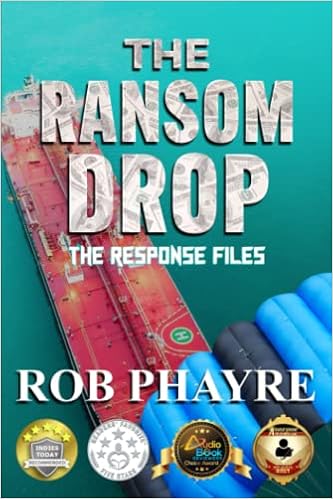
Novels Written by Experts: Reviewing The Ransom Drop


Finished a fascinating novel by Rob Phayre, The Ransom Drop, narrated on Audible. 


I'm not sure there's an elite category for "procedural" thrillers written by expert practitioners. If so, Ransom Drop would fit in that category. Author Phayre was a lead consultant in arranging for thirty ransom deliveries in and around Somalia. 

The novel narrates the seizure of Hibernia III, a supertanker chartered to carry gasoline and other petroleum products to Mombasa, Kenya. 

Ransom Drop, unlike the typical thriller that paints antagonists in simple tones of evil, offers a close view of life in the Somali beachfront village that serves as the pirates' base. Phayre manages to get the reader to regard them with some empathy, while also making it clear that piracy poses great danger to people and the ocean environment. Even if nobody is killed in the process, it corrupts the economy, wastes resources, and traumatizes the hostages. 

Unlike the authors of thrillers who work mainly from news articles or their imagination, and would quickly pass over how an emergency response team acquires cash, equipment, and weapons, Ransom Drop walks the reader through every detail. For example: assembling a pallet-load of fresh currency and shifting it from a bank in Athens to a bizjet at the city airport takes days of paperwork and the efforts of many people, including a "cash in transit" firm that is bonded and insured to move such sums a few miles here or there. We learn about the precautions the shipowner's team takes to see that the pirates fulfill their part of the deal: freeing hostages, ship, and cargo. 

We see into the psychological tactics that negotiators use to move the dealings forward while not giving up too much. All this is done under the eyes of a lawyer for the shipowner's insurance firm. We can hope pirates don't take up Phayre's book -- they'd probably learn some things. 

While very little is left out of the process, Phayre does mention without elaborating that the families of the hostages, if they take advantage of press coverage, can interfere with the steps being taken by shipowner, response team, and insurance company. Families and reporters are not part of the ensemble of this book.

Phayre does combine past and present. The narrative appears to be set partially in the present, given the references to some present-day technology. But it also reaches into the past, presenting this hijacking as the first one along the Somali coast. The pirates have to learn how to board a supertanker and subdue its crew with only three fighters; and the response team has to figure how to deliver hundreds of pounds of cash without something going wrong.

Know Your Adversary: Another Lesson from World War II

Sun Tzu advised leaders to know the enemy as well as they know themselves. It’s sound advice … so sound that it’s rarely taken. 

Lesson from World War II:  Besides Mein Kampf, one opportunity to see into the enemy’s goals and fears before the war was a German book called Germany Prepares for War (1933), laying out its propaganda case for aggression. Another harbinger of events was the German and Japanese reaction to a set of books by the American expatriate Homer Lea. Two decades before World War II, Lea predicted the general outlines of the war along with weaknesses in American and British defenses. 


Immediately after Pearl Harbor, American air war planners identified targets across the Reich, using documents drawn up to support industrial loans. The British used their own research efforts when organizing hundreds of deception operations. These shielded Allied efforts, wasted the enemy’s effort, and exploited weaknesses among the Axis. One of the most interesting was a plan dubbed “Headache for Der Fuerher,” which used faked communications to force the recall of a highly effective commander of a Panzer division in North Africa. The British did this by making the Gestapo believe that a disgraced German officer was sending secret, conspiratorial messages to the commander the British had targeted for removal. 

Fortunately for people today who take Sun Tzu’s advice seriously, adversaries still reveal their agendas in books, articles, or speeches. Often these are written early in their careers, before they gain power. Or they are written by others. Jihadists swear by Sayyid Qutb’s Signposts and Abdel Salam Faraq’s Neglected Duty

Those who wonder about Vladimir Putin’s plans should read his biography of 2000, Ot Pervogo Litsa: Razgovory s Vladimirom Putinym (“From the First Person, Vladimir Putin”). And even before that book and before taking power, back in graduate school, Putin wrote that he wanted to build a new empire founded on controlling access to energy, with a strong authoritarian figure at the center. The Caucasus is an energy corridor (what World War II theorists in logistic science called a “center of gravity”) and therefore is critical to that plan. To put a measure on Putin’s ambition, think of Peter the Great. His biography describes the significance of the Great Patriotic War in his family background, and his love of martial arts training (called sambo). 

Monday, August 9, 2021

"One Thing:" Remembering keen insights

 By "One Thing," I mean a statement you heard that sticks in your mind .. an observation that lasts for years! It could be advice a person had about living, or an insight from their work experience. 

My dad was a construction-machinery dealer so he did a lot of dickering on equipment transactions. I remember this advice: “If you’re not willing to walk away when someone makes an offer, you can’t negotiate!”

Here are some I've collected over the years from my interviews. 

 =====

On helicopter cross-country travel: “I don’t do unplanned back-lot landings because I don’t know the municipal attitude. They all have to have a say in helicopter landings. You’re walking into trouble to do that kind of thing.”  Actor and helicopter pilot Harrison Ford

On tall-tower work: “Sometimes you can see waves coming at you in the cloud banks. There's a certain thrill to it, but you have to appreciate that you can die. I remember a foreman asking me, 'Are you scared about this?' I said, `Yep!' And he said, `Good! That'll keep you alive. If you stop being scared, you're in trouble." Nate McIlhaney, steeplejack 

“They say you can teach a monkey to fly, but to know the systems is very important. If you know what the aircraft will do in all circumstances you can save yourself.”  Alaskan helicopter bush pilot Mel Campbell

On the World War 2 shipbuilding miracle: "One thing we did to make the Kaiser shipbuilding yards succeed was to send out expediters across the country. These were men who located and cleared up logjams that blocked supplies or equipment we’d ordered and weren’t getting. There were just two rules: no rough stuff, and never give up."  Clay Bedford, Henry Kaiser's key man in the WWII shipbuilding effort

On leadership: “You have to know where the decisive point is. That's where a leader is supposed to be.”  John Novomesky of IBM, on his West Point training

On coping with first-hand disaster: “The things I saw inside the wreckage could be called horrifying – what happened to the people caught inside. But it didn't bother me and it still doesn't. To me, those bodies were husks. Their spirits had left.”  Greg Gothard of The Washington Group, on his work in body recovery at the collapsed Marriott World Trade Center Hotel.

On astronauts and deep-space exploration: “You can automate the piloting really well, such as for landing. That you can do. The real question is the on-site judgment, to sense the situation and make rational judgments. Man’s unique ability is to assimilate data and make decisions, not to be an expensive replacement for robots.”  Ed Gibson, who in 1973-1974 flew on the third mission to Skylab

On backcountry travel: “I use the four-wheel drive to get out of trouble, not into it.”  Phil Thomas of Gerlach, Nevada, on crossing the Black Rock desert in his pickup “Grapes of Wrath”

On tunnel work: "It can be dangerous enough, so we work together. It's not the wild rushing about that you might see other places. We call that highballing, when you rush too much."  Charlie McWilliams on sandhog work in the deep tunnels of New York City

On oil exploration: "Just pretend you're going to Las Vegas. If you've got money you can afford to lose, fine, but don't take the kids' savings." Danny Biggs, oilfield superintendent

On the long-term life of buildings: “The idea of a 50- or 100-year life span for buildings is patently ridiculous. There's no structural reason not to go on and on. The effective life span is completely dependent on those who maintain them. Properly maintained, a building is ageless."  Structural engineer Leslie Robertson, chief engineer for the World Trade Center towers

On persistence: “There ain't no hold that can't be broke.” Major General Robert Littlejohn, before tackling the war-surplus problem that remained after WWII

On training for emergencies: “We want to avoid chaotic responses. Two or three seconds of panic can kill, but one or two seconds of thinking can save you.”  Chris Judah, executive director at Survival Systems, which teaches how to escape from crashed and sinking aircraft

On unpublicized Cold War plans: “You didn't want to have the fireball touch the ground. But there might be decisions to make, say if you had a lot of Russian bombers coming in, not just a couple. You might say 'To hell with it' and accept some fallout. That's if you knew absolutely it was Russians and they had 25 megatons on board.”  Frank Evans, former Nike base executive officer, on the authority that Army antiaircraft batteries had in the 1960s to launch nuclear-tipped missiles for detonation at low level over American cities

On trying to see orbital hazards from a space station: “We always looked outside [during the close passes] to spot oncoming objects and it was inevitably futile. Imagine trying to see a small dot ten kilometers away over your left shoulder, and a second later it's right next to you, and another second later it's ten kilometers over your right shoulder."  Astronaut Michael Foale on trying to spot orbiting objects while on station Mir

Saturday, March 27, 2021

Ever Given: Cork in a Bottleneck

Observations on the Ever Given, in FAQ style.

Is the ship still stuck? As of almost midnight local time, March 27, it was. There's some hope, perhaps exaggerated, of it being freed tomorrow. Here's a link to Marine Traffic, giving its status. Scroll down to the map labeled "show live traffic."

How big is the ship? 1,312 feet long and 192 feet wide. 

How much does it weigh? Ship tonnage is measured several ways. Deadweight tonnage, or DWT, is how much a ship can carry to its maximum draft, meaning cargo, fuel and supplies. Ever Given's DWT is about 199,000 tons.  The other important figure is “lightweight tonnage,” and it's the mass of the hull and structure before it left the shipyard, and without fuel, water or supplies. Putting deadweight and lightweight tonnage together, the total weight of Ever Given could be 240,000 tons. 

Why did it happen? No official word, but after initial blame pointed to high winds and a sandstorm, now some reports suggest human error may have figured into itAt the time (7:40 local on March 23) there were 19 other ships in a northbound convoy. As far as I know none of the others went aground. Most of the ships were astern of Ever Given. (Photo, Copernicus Sentinel, from Wikimedia)

Is there a detour at this point?  No. The canal does have a smaller channels that could be used as a bypass, but there's no such bypass where Ever Given got stuck. There must have been some close calls, with those trailing ships barely able to stop in time. 

Photos don't make the Ever Given's problem look all that serious. Why can't it be simply pulled backwards at an angle, to set it straight with the canal? This seems like a very reasonable question! But lots of tugs have tried that already, and if it were simply a matter of a bigger pull, then strand jacks deeply fastened to the shore could provide thousands of tons of pull. Salvors call that arrangement of winches and deadman anchors "beach tackle." See my blog post about the awesome power of strand jacks

But the situation here is not that simple: when a fully loaded ship has a big portion of its tonnage resting on land, and that's the Ever Given, then simply adding more winches risks tearing the ship apart. 

Consider how badly the ship is stuck. From photos, it may appear that only the ends are stuck. The turquoise-blue surface of the canal makes it look like the canal has the cross section of a swimming pool; it looks deep all the way across. (Photo, Container News)

But in fact it's a sand and dirt trench with a very flat profile. Only the middle third of the canal is deep enough for a giant boxship like Ever Given. When it turned the wrong way and headed for the bank, the ship had so much momentum it ran itself up a gentle slope of mud, digging a furrow perhaps three hundred feet long and raising the forward section ten or more feet higher than the stern. 

The stern slewed sideways so it's probably not as hard up as the other end, but the important thing to salvors is that the ship is sitting on the ground in the bow and stern, while the midships part is floating. So whenever the tide is low (and it varies by about five feet) the middle of the ship wants to sag. 

What about dredging? Salvage expert Nick Sloane says a very thoughtful dredging approach, along with removing some weight from the midships by pumping out tanks there, looks like the best bet. The Suez authorities certainly hoped dredging would solve the problem, because they started dredging even before the owner signed Lloyd's Open Form and hired a salvor. 

Is there any risk with dredging? Yes. Salvors want to study the ship's loading and hull in detail, and the seabed profile, before taking action. I'm guessing that one risk is this: if dredging were to take the seemingly obvious choice and concentrate on removing the mud nearest the middle of the ship, then working toward the ends, then the sagging problem gets worse since the middle portion is going to be less supported than it was on the first day.

Is the ship damaged? There is flooding in the bow thruster room, but that may not be too big a problem. Some damage was to be expected because the bow crashed into a rock barrier. I wouldn't be surprised if the stern, the rudder and screws in particular, sustained damage from the sideways slide into the mud. A big worry would be cracks appearing in the lower parts of the middle part of the hull, then lengthening.

Can the ship be lightened by removing the containers? The ones in the middle are the priority but this would be a last resort and very slow, whether done by the world's most powerful helicopters or very large floating cranes, one on each side. Such cranes would have to be more than two hundred feet high and long enough to reach the middle stacks of containers, which are a hundred feet from the sides. I haven't seen much information on the floating-crane option yet.