Comments about technological history, system fractures, and human resilience from James R. Chiles, the author of Inviting Disaster: Lessons from the Edge of Technology (HarperBusiness 2001; paperback 2002) and The God Machine: From Boomerangs to Black Hawks, the Story of the Helicopter (Random House, 2007, paperback 2008)

Sunday, November 13, 2022

Writers' Walls

What do writers hang on their walls? Here are two items on my office wall, along a profile of our cat, who looks like he's checking for dust on the frame. 

These are two of six illustrations by Paul Breeden for my first article in Smithsonian Magazine, "Engineers Versus the Eons," March 1984. 

Paul's Facebook is linked here.  

My article speculated on what would happen to three great American structures if civilization collapsed and they were abandoned to the ages, as the Ancient Wonders of the World were. The painting on the right depicts the South World Trade Center tower having collapsed due to rusting in the basement. 

That was based on an interview I had with Les Robertson, the WTC's chief structural engineer. He said that, assuming failure of the PATH tunnels or heat exchanger lines allowed the basement to flood with brackish water from the Hudson, those massive steel columns would rust and eventually fail. 

I explained it this way: "Rust is nature's way of returning steel to iron ore by combining it with oxygen. Oxygen is richest at the tidal zone, where water rises and falls daily."

The illustration on the left imagines a collapse of the Gateway Arch following a tornado. The Arch's engineers told me that a break would most likely happen at the 300-foot elevation, where the concrete-stiffened lower section of the structure meets the stainless-steel-only, hollow upper section. After hundreds of years of no maintenance, corrosion of the stainless steel would grow into cracks, making a weak point. 

Friday, November 4, 2022

More experiments with DALL-E-2: Outpainting

This gives an idea of how the Outpainting tool can add a lot to the AI's initial square image. 


The original, in the center, was from my prompt asking for an underground spaceship-repair station. 

It's important to update the description in the prompt line when asking DALL-E for side images -- you want something that's related to the initial image, but different enough to be interesting. 


Tuesday, October 25, 2022

Old Meets New: Feeding ViaVoice speech-to-text into DALL-E-2

Circa 1999, when our boys were in school, we discovered that the iMac could turn speech into text. And the achievement was amazing, in a primitive sort of way. The iMac was a sluggish computer by today's standards, and IBM's ViaVoice program was freestanding, using only the algorithms stored on floppy disks, with no access to online algorithms.

We took turns reading aloud sections from The Three Musketeers, Tom Swift, and The Boxcar Children to see what would happen. 

ViaVoice made a heroic effort. A 1994 IBM factsheet claimed its software could render speech with complete accuracy. Well, no. It did turn out authentic words, and sometimes the sentences were grammatically correct, but the meaning rarely carried through.

Fed a line about somebody liking to eat ice cream, ViaVoice returned with "Islam is a beautiful blue dream."

We liked that phrase, and lately I fed it into DALL-E-2. Here's the result of the computers' unlikely partnership:


Saturday, October 15, 2022

DALL-E-2: Weird and somewhat wonderful

Some thoughts on the AI image generator DALL-E-2 ...  While not a substitute for a professional artist, it's good for working out ideas, and for illustrating books for one's grandkids. 

Results were the most interesting when it struggled with my text prompt.  

When I asked for a giant mech embracing the Statue of Liberty, it substituted the mech for Lady Liberty instead:

It likes to make sunbeams, even when I didn't ask for them, as when rendering a mech in the harbor:

When I asked for a mech in the pose of The Thinker, it plugged in a despairing superhero guy. Was it thinking of Ozymandias?


When I asked for a city park in the evening, it came up with a statue of a floppy sea creature, and cut off the bottom third of the image:

This eerie result after asking for a whale pulling a boat under a full moon:


More to come!


Tuesday, March 1, 2022

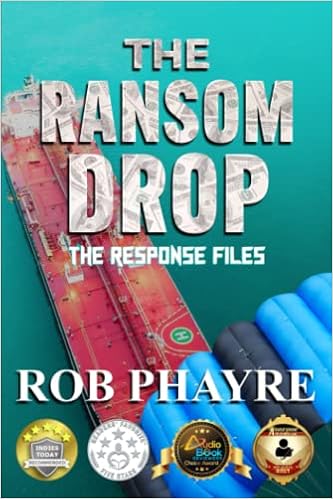
Novels Written by Experts: Reviewing The Ransom Drop


Finished a fascinating novel by Rob Phayre, The Ransom Drop, narrated on Audible. 


I'm not sure there's an elite category for "procedural" thrillers written by expert practitioners. If so, Ransom Drop would fit in that category. Author Phayre was a lead consultant in arranging for thirty ransom deliveries in and around Somalia. 

The novel narrates the seizure of Hibernia III, a supertanker chartered to carry gasoline and other petroleum products to Mombasa, Kenya. 

Ransom Drop, unlike the typical thriller that paints antagonists in simple tones of evil, offers a close view of life in the Somali beachfront village that serves as the pirates' base. Phayre manages to get the reader to regard them with some empathy, while also making it clear that piracy poses great danger to people and the ocean environment. Even if nobody is killed in the process, it corrupts the economy, wastes resources, and traumatizes the hostages. 

Unlike the authors of thrillers who work mainly from news articles or their imagination, and would quickly pass over how an emergency response team acquires cash, equipment, and weapons, Ransom Drop walks the reader through every detail. For example: assembling a pallet-load of fresh currency and shifting it from a bank in Athens to a bizjet at the city airport takes days of paperwork and the efforts of many people, including a "cash in transit" firm that is bonded and insured to move such sums a few miles here or there. We learn about the precautions the shipowner's team takes to see that the pirates fulfill their part of the deal: freeing hostages, ship, and cargo. 

We see into the psychological tactics that negotiators use to move the dealings forward while not giving up too much. All this is done under the eyes of a lawyer for the shipowner's insurance firm. We can hope pirates don't take up Phayre's book -- they'd probably learn some things. 

While very little is left out of the process, Phayre does mention without elaborating that the families of the hostages, if they take advantage of press coverage, can interfere with the steps being taken by shipowner, response team, and insurance company. Families and reporters are not part of the ensemble of this book.

Phayre does combine past and present. The narrative appears to be set partially in the present, given the references to some present-day technology. But it also reaches into the past, presenting this hijacking as the first one along the Somali coast. The pirates have to learn how to board a supertanker and subdue its crew with only three fighters; and the response team has to figure how to deliver hundreds of pounds of cash without something going wrong.

Know Your Adversary: Another Lesson from World War II

Sun Tzu advised leaders to know the enemy as well as they know themselves. It’s sound advice … so sound that it’s rarely taken. 

Lesson from World War II:  Besides Mein Kampf, one opportunity to see into the enemy’s goals and fears before the war was a German book called Germany Prepares for War (1933), laying out its propaganda case for aggression. Another harbinger of events was the German and Japanese reaction to a set of books by the American expatriate Homer Lea. Two decades before World War II, Lea predicted the general outlines of the war along with weaknesses in American and British defenses. 


Immediately after Pearl Harbor, American air war planners identified targets across the Reich, using documents drawn up to support industrial loans. The British used their own research efforts when organizing hundreds of deception operations. These shielded Allied efforts, wasted the enemy’s effort, and exploited weaknesses among the Axis. One of the most interesting was a plan dubbed “Headache for Der Fuerher,” which used faked communications to force the recall of a highly effective commander of a Panzer division in North Africa. The British did this by making the Gestapo believe that a disgraced German officer was sending secret, conspiratorial messages to the commander the British had targeted for removal. 

Fortunately for people today who take Sun Tzu’s advice seriously, adversaries still reveal their agendas in books, articles, or speeches. Often these are written early in their careers, before they gain power. Or they are written by others. Jihadists swear by Sayyid Qutb’s Signposts and Abdel Salam Faraq’s Neglected Duty

Those who wonder about Vladimir Putin’s plans should read his biography of 2000, Ot Pervogo Litsa: Razgovory s Vladimirom Putinym (“From the First Person, Vladimir Putin”). And even before that book and before taking power, back in graduate school, Putin wrote that he wanted to build a new empire founded on controlling access to energy, with a strong authoritarian figure at the center. The Caucasus is an energy corridor (what World War II theorists in logistic science called a “center of gravity”) and therefore is critical to that plan. To put a measure on Putin’s ambition, think of Peter the Great. His biography describes the significance of the Great Patriotic War in his family background, and his love of martial arts training (called sambo). 

Monday, August 9, 2021

"One Thing:" Remembering keen insights

 By "One Thing," I mean a statement you heard that sticks in your mind .. an observation that lasts for years! It could be advice a person had about living, or an insight from their work experience. 

My dad was a construction-machinery dealer so he did a lot of dickering on equipment transactions. I remember this advice: “If you’re not willing to walk away when someone makes an offer, you can’t negotiate!”

Here are some I've collected over the years from my interviews. 

 =====

On helicopter cross-country travel: “I don’t do unplanned back-lot landings because I don’t know the municipal attitude. They all have to have a say in helicopter landings. You’re walking into trouble to do that kind of thing.”  Actor and helicopter pilot Harrison Ford

On tall-tower work: “Sometimes you can see waves coming at you in the cloud banks. There's a certain thrill to it, but you have to appreciate that you can die. I remember a foreman asking me, 'Are you scared about this?' I said, `Yep!' And he said, `Good! That'll keep you alive. If you stop being scared, you're in trouble." Nate McIlhaney, steeplejack 

“They say you can teach a monkey to fly, but to know the systems is very important. If you know what the aircraft will do in all circumstances you can save yourself.”  Alaskan helicopter bush pilot Mel Campbell

On the World War 2 shipbuilding miracle: "One thing we did to make the Kaiser shipbuilding yards succeed was to send out expediters across the country. These were men who located and cleared up logjams that blocked supplies or equipment we’d ordered and weren’t getting. There were just two rules: no rough stuff, and never give up."  Clay Bedford, Henry Kaiser's key man in the WWII shipbuilding effort

On leadership: “You have to know where the decisive point is. That's where a leader is supposed to be.”  John Novomesky of IBM, on his West Point training

On coping with first-hand disaster: “The things I saw inside the wreckage could be called horrifying – what happened to the people caught inside. But it didn't bother me and it still doesn't. To me, those bodies were husks. Their spirits had left.”  Greg Gothard of The Washington Group, on his work in body recovery at the collapsed Marriott World Trade Center Hotel.

On astronauts and deep-space exploration: “You can automate the piloting really well, such as for landing. That you can do. The real question is the on-site judgment, to sense the situation and make rational judgments. Man’s unique ability is to assimilate data and make decisions, not to be an expensive replacement for robots.”  Ed Gibson, who in 1973-1974 flew on the third mission to Skylab

On backcountry travel: “I use the four-wheel drive to get out of trouble, not into it.”  Phil Thomas of Gerlach, Nevada, on crossing the Black Rock desert in his pickup “Grapes of Wrath”

On tunnel work: "It can be dangerous enough, so we work together. It's not the wild rushing about that you might see other places. We call that highballing, when you rush too much."  Charlie McWilliams on sandhog work in the deep tunnels of New York City

On oil exploration: "Just pretend you're going to Las Vegas. If you've got money you can afford to lose, fine, but don't take the kids' savings." Danny Biggs, oilfield superintendent

On the long-term life of buildings: “The idea of a 50- or 100-year life span for buildings is patently ridiculous. There's no structural reason not to go on and on. The effective life span is completely dependent on those who maintain them. Properly maintained, a building is ageless."  Structural engineer Leslie Robertson, chief engineer for the World Trade Center towers

On persistence: “There ain't no hold that can't be broke.” Major General Robert Littlejohn, before tackling the war-surplus problem that remained after WWII

On training for emergencies: “We want to avoid chaotic responses. Two or three seconds of panic can kill, but one or two seconds of thinking can save you.”  Chris Judah, executive director at Survival Systems, which teaches how to escape from crashed and sinking aircraft

On unpublicized Cold War plans: “You didn't want to have the fireball touch the ground. But there might be decisions to make, say if you had a lot of Russian bombers coming in, not just a couple. You might say 'To hell with it' and accept some fallout. That's if you knew absolutely it was Russians and they had 25 megatons on board.”  Frank Evans, former Nike base executive officer, on the authority that Army antiaircraft batteries had in the 1960s to launch nuclear-tipped missiles for detonation at low level over American cities

On trying to see orbital hazards from a space station: “We always looked outside [during the close passes] to spot oncoming objects and it was inevitably futile. Imagine trying to see a small dot ten kilometers away over your left shoulder, and a second later it's right next to you, and another second later it's ten kilometers over your right shoulder."  Astronaut Michael Foale on trying to spot orbiting objects while on station Mir