Comments about technological history, system fractures, and human resilience from James R. Chiles, the author of Inviting Disaster: Lessons from the Edge of Technology (HarperBusiness 2001; paperback 2002) and The God Machine: From Boomerangs to Black Hawks, the Story of the Helicopter (Random House, 2007, paperback 2008)

Friday, April 4, 2014

The Inhuman History of ROVs: Part 1

(The following is adapted from my article on ROV history for Invention & Technology Magazine).

= = = =

The emergency response to the April 2010 blowout over the Macondo well was a boom time for publicity about deepwater technology. At first, the camera feeds perplexed millions. Why hadn't they heard about any of this stuff, pre-explosion? The short answer is that ROVs spend most of their time working for the deepwater drilling industry, and that's a field that  prefers a low profile.
 
I first spent time with ROVs and their wranglers fourteen years ago, on a deepwater-drilling ship I was visiting for a feature article in Smithsonian.
 
Until the Macondo blowout, deepwater ROVs were over the horizon and out of mind. They resurfaced as supporting actors during James Cameron's Deepsea Challenger record-breaking stunt two years ago, and now ROVs are back in the news for a little while, assuming MH370 wreckage is found (... and I'm predicting it will be, in the general vicinity of 97E / 30S).
“It's like there are whole underwater cities down there, the installations are so big and complicated,” said Robert Wernli, a retired ROV builder for the Navy, about subsea oil developments. “And it's all installed remotely.”

No human eye can look down on the entire landscape we've been busy building down in the dark, but at least we know that these boxy underwater robots are the A-Team, in fact the the only team, when things need fixing in deep, dark places (Offshore Angola photo, BP):


But ROVs have worked such jobs before. ROVs plucked an H-bomb off a ledge in the Atlantic in 1966, snipped a Russian submersible loose from a steel antenna, patched up hurricane-ravaged pipelines, and (on numerous occasions) have helped lasso giant hunks of drilling equipment out of deep silt following mishaps above. In deepwater operations around the world, from Brazil to Asia, nothing can touch ROVs for doing yeoman's work at negligible risk to humanity: not divers in heated suits breathing exotic gas mixtures nor people riding around in little submersibles with claws and cameras.
 
While divers still offer a unique ability to wiggle into tight spaces and fix a problem by feel alone, they can't survive in deepwater fields. Even high-tech “atmospheric diving suits” -- hard-shelled suits with mandible arms – can't bring a diver deeper than 2,300 feet and that's at the cost of much human agility.

Common oilpatch wisdom once regarded ROVs to be economic only for jobs deeper than a thousand feet; divers would do the rest. Now, said Drew Michel, ROV consultant and adviser to the Marine Technology Society, the oil industry is hiring ROVs to do work in waters as shallow as 150 feet. This was once the exclusive domain of commercial divers. “We know what they can do now, and how to use them.”

Because water squelches conventional radio waves, the “remotely operated” aspect depends on a tether that bundles electrical and communication lines. While the operator can be floating nearby inside a tiny manned submersible linked by tether, the operator usually works from a control room aboard the specialized subsea-intervention vessel that hosts the ROV, on the surface. A typical ROV has two crews working in the background, each with three crewmen working 12-hour shifts.

Here's how an oilfield ROV's long night begins: up top, an ROV has been given the order to go over the side on a specific mission, say to replace anti-corrosion anodes at a pumping station in the Mississippi Canyon. Because each trip down and up wastes valuable time, mechanics make sure that all tools and new anodes it will need are sent along. Mechanics also ensure that the buoyancy of the ROV is right for the payload on board the 6,000-foot depth of the worksite.

With the ROV clamped securely inside a transport cage, safe from being jounced around, the rig rolls down a vertical track bolted to the ship. Along with its thick umbilical line, it vanishes under the waves in a cloud of bubbles. Having reached the end of the track and well below the worst turbulence, the cage unhitches from its track and begins the long plunge, hanging at the end of a heavy umbilical cable that provides all services of a tether, but is reinforced to bear the weight of ROV and cage. The winch operator stops the cage before it touches down at the bottom; this avoids stirring up silt each time the ROV returns to fetch another tool or spare part. To save valuable time, every aspect of the job has been planned and run on a simulator. Using the high definition TV cameras, the operator moves in and orders the ROV to get a grip on the nearest metal structure with one claw, and starts yanking old anodes with the other.
 
ROV movements need a high level of three-dimensional coordination during a complicated response such as wreck recovery or troubleshooting at a wellhead, where a half dozen can be on the job at once. In addition to all other work, someone must track their movements ensure that the ROVs don't get their tethers in a knot. (Upon command, or if contact is lost for an extended period, ROVs can cut their tethers and slowly rise to the surface to await rescue.)

In the pre-ROV era, any work at depth was done by divers wearing heavy suits of rubber, canvas and metal. They clomped along the seafloor in weighted boots, and even heavier helmets, supplied with air pumped through rubber hoses by tenders. Typical work, done at harbor depth, was bolting together underwater pipelines, repairing ships, and salvaging useful goods from sunken ships that could not be patched and raised.

Advances in SCUBA tanks and regulators, decompression equipment, and specialized deep-diving mixtures of hydrogen, helium and oxygen later made it possible to go much deeper.
 
Divers with the French company COMEX set a world record of 530 meters in one trial, but at enormous risk. Actual work was barely possible at half that depth, for brief periods followed by many days of decompression. (Sorry, Abyss movie fans: no divers ever went down to the sea with liquid-filled lungs -- there were experiments, but not with divers.)

But, says Drew Michel, such ultra-deep diving achievements lack practical meaning, given the risks and expense: “No oil company in their right mind would depend on such a dive,” he told me. Costs are fantastically high, the work cannot go continuously, and a single injury shuts down the entire work flow.

At first the limits of deep diving seemed to point toward the manned submersible, a mini-submarine out of which a crew would wield tools. In the mid-1960s high-tech corporations practically swooned over such machines, because (surely) they would open up the deeps to mineral exploration. And this was a time where nearly everybody worried about strategic minerals.
 
The mania over manganese nodules and other bounty touched even companies with no experience in the subject. American corporations investing in undersea tech included Westinghouse, Northrop Grumman, North American Rockwell, Lockheed, General Dynamics, Hughes Tool, and Litton Industries. “Every major defense contractor went into it,” said Robert Wernli, ”but after they found the certification requirements were so expensive to meet, most of the machines built went on blocks for display.” Even General Mills, maker of cake mixes and cereals, got into the act by applying for, and winning, a submersible government contract.

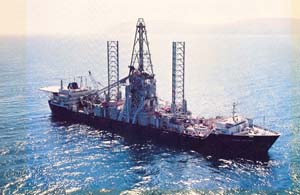
“Most of the companies entered because they saw Howard Hughes getting involved, but he was after a Russian submarine instead,” said Drew Michel, referring to the CIA-backed Hughes Glomar Explorer, aka Project Azorian (Photo, US Government):
 
 
Among the few craft launched were Alvin, started by General Mills, but finished by Litton (Photo, General Mills) ...
 
 
... and Beaver Mark IV, built by North American Rockwell, also known as Roughneck (Photo, omegamuseum.com):
 
 
The builders equipped Roughneck with manipulators to serve as an undersea workboat that could install subsea oil and gas equipment in half-mile deep waters. Assuming that oilfield equipment would always need the human touch, most concepts for deepwater oilfields circa 1973, such as Exxon's, expected that fleets of diving bells and submersibles would shuttle workers from the surface down to steel capsules encapsulating wellheads and pumps. Workers would climb from submersible to capsule, carry out their jobs in “shirtsleeve” if claustrophobic conditions, and return to the surface.
 
ROVs would have played a minor part in such a human-centered plan (which is portrayed in Abyss, by the way).
 
While some experiments along this line were carried out, an entire infrastructure based on thousands of “subsea work enclosure” capsules scattered across the seafloor was neither safe nor practical. Until this was discovered (see Part 2), the unmanned subs now known as ROVs were merely a curiosity, and of interest only to the military, treasure hunters, and scientists.

Thursday, April 3, 2014

Radarscope App, Highly Recommended

I don't make a lot of product recommendations, but lately have been trying out an iPhone app popular with those who chase storms (... or who are chased by them), Radarscope. It's $9.99, and well worth it.

Have been using it tonight to look at storms my Missouri relatives are seeing: most useful!

Users can select different NEXRAD stations, different radar frequencies, different tilt angles ... see storm tracks, and even draw on the screen.
 
The radar mode in use is SuperRes Reflectivity, tilt angle 3.

Sunday, March 30, 2014

The Search Will Go On, Pings or No Pings

Despite many breathless news reports about how time is running out on the battery life of digital voice and data recorder underwater locator beacons, TV-watchers should feel confident that the MH370 recovery effort won't stop after thirty days, or forty days either. There's too much at stake: we can't make fixes until we know the root cause, whether it's humans, mechanical, or electrical (I still lean to the latter). People will keep looking for answers, however long it takes.
 
Progress will begin once any wreckage is found, particularly if that includes structural components like wing spars. Structural parts and engines can help explain how the plane met the water: flat in a stall, nose down in a powerless dive,  or gliding as if under control.
 
One historical reminder that it's possible to solve profound aeronautical mysteries even without a "black box" DFDR is in this photo (credit, AFP):
 
 
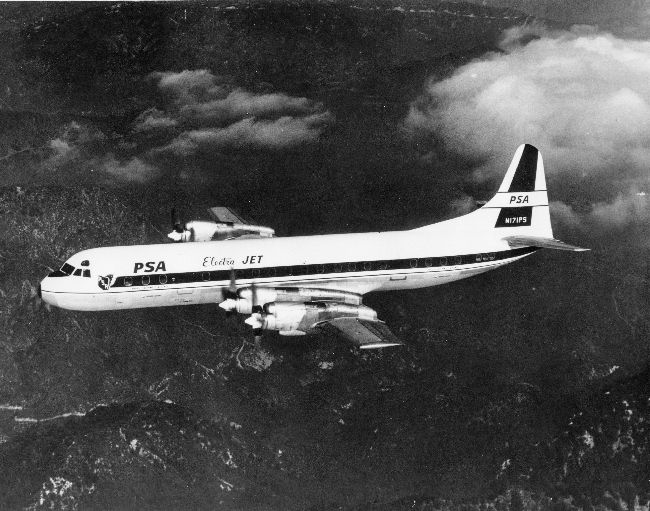
 It's the plane in the background: A P3 Orion operated by the Japanese Maritime Self-Defense Force, the airframe of which is based on the Lockheed L-188 Electra, an airliner of the late 1950s (photo, Wiki Commons):


Early in its life as an airliner, the Electra presented a serious problem, two mysterious, mid-air airline disasters: one over Texas, and one over Indiana. As wings broke away and the airplanes fell to earth, the engines produced an eerie howl that bystanders described as unearthly. 

Work was hamstrung by the lack of flight data recorders on such aircraft. Result: the initial theories couldn't account for the full combination of the few facts that were known. 

But in time, study turned up the major causes behind it: propeller rotation that could resonate with the wing-bending frequency, and seemingly minor damage to engine mounts before the flights in question. The engine-mount damage had allowed the big propeller just enough wiggle room for the problem to catch hold.

After some pretty daring flight testing, Lockheed confirmed a set of solutions to what became known as whirl-mode flutter.

Here's a film of Electra tests at Langley:


Here's a snippet from a feature on flutter from Air&Space, "The Hammer," by Peter Garrison:

"As early as 1938, a study on powerplant vibrations had raised the possibility of propeller whirl inducing structural flutter. But the relative weights of engines and propellers, the stiffness of propeller shafts, and the engine power outputs that were typical in the late 1930s made it a practical impossibility. As Lockheed mathematician Robert Donham, who participated in the accident investigation, says today, 'Probably nobody involved with the design of the Electra even knew the paper existed. Nobody thought about whirl-mode vibrations causing flutter.'

"Lockheed's flutter analysts reprogrammed their computer to include whirl mode, and the mechanism of the accidents began to emerge. By an unlucky coincidence, the whirl-mode frequency of the Electra's big four-blade propellers happened to match the flapping frequency of the wing. The propellers, like the child driving a swing higher by small movements of her body, had eventually caused the wing to flap so violently that in 30 seconds it broke at the root without the propeller whirl ever overloading the nacelle structures.

"Microscopic examination of fractures in the wreckage of the two airplanes revealed engine mount damage that had preceded the inflight breakups. The cause of the earlier damage was uncertain--in one case a hard landing was suspected--but Lockheed redesigned the engine mounts and no Electra ever suffered from whirl-mode flutter again."

As did the catastrophic in-flight breakup of two Comet airliners in early 1954 over the Mediterranean, the troublesome beginnings of the Lockheed Electra L-188 proved the need for flight recorders. While both investigations eventually succeeded without such data, had good information been available right away from flight recorders, the later crashes might have been avoided. In short, time is of the essence.

Friday, March 21, 2014

Hunt for MH370: Time to put the X-37B to work

This would be a great time for the USAF to equip, launch, and employ the fast-reaction X-37B military spaceplane, an unmanned mini-shuttle that has already been up in orbit for extended-duration missions.

Yes, it's super-secret but it could pay its way.

It's likely that it can carry radar that would be well suited for detecting floating metal objects in the Indian Ocean if launched on a polar orbit.

My original post on this very cool craft is here.

Wednesday, March 19, 2014

MH370: Can we stop telling ghost stories now?

Whether or not the latest report about possible floating objects from MH370 in the southern Indian Ocean is accurate -- we'll know that in a short time -- I have to say the constant stream of conspiracy and murder theories parading across cable TV for the last week are simply maddening to families and (some) viewers. It's been completely lacking in rigor, founded on strings of thin speculation, and morphing to fit whatever tidbits sources and clueless authorities have passed along, even when those tidbits were retracted hours later.

Among the most ridiculous notions, in my mind:
  • That the schemers would thread a ridge-hugging route through the mountains at night so they could land and hold the airplane hostage, with the supposed reasons for this changing by the hour;
  • That they could keep an entire planeload of electronics-toting passengers silent as the plane flew over populated territories, including any pax with handheld satellite phones;
  • That the early, wild flight maneuvers soon after MH370 left its standard course were an attempt to evade radar; or
  • That the plane landed in a well-populated area but was hidden in a massive cover-up.
Certainly the course changes, timeline, and lack of communication make it hard for any theory to stand up so far, barring an electrical fire that knocked out a wide range of electronics and incapacitated the crew and passengers.

If the flight data recorder is ever found and recovered, we'll find out a lot. (It's possible that the voice recorder (CVR) may have been overwritten, though, if the aircraft continued for seven hours after whatever weird event took it from its course.)

Skeptics are free to criticize the "system failure" notion, but should acknowledge that the 777 for all its virtues has not been perfect, the failure of a navigational core unit on a Malaysia Air flight in 2005 (the ADIRU) being one example. In that case, an apparently impossible combination of events came very close to crashing the plane. Yes, Boeing has ordered thorough precautions against a repeat, but what other gremlins lie in wait?

With thorough flight automation, unfortunately, also comes the possibility of rare but terrifying failures.

Saturday, March 15, 2014

Malaysia Airlines 370: Intentional Destruction? Not so fast

I don't think intentional destruction by someone on board is the best fit for the the irregular public disclosures about MH370's flight path. While it makes sense for investigators to pursue that possibility, to me, it's a weak hypothesis.

Fly-by-wire jets are extremely complex devices with novel modes of failure (see the subject "sneak circuit analysis"), and a common cause such as an electrical fire in the avionics racks could help explain more than a few of the circumstances: the erratic flight path, a crew disabled by hypoxia, abrupt altitude changes, transponders going off line ... in any case, more posts to follow.

Monday, March 10, 2014

Malaysia Airlines Flight 370: A rare case

After almost three days, authorities tell us, there's not a trace of the Boeing 777-200ER flying as MH370 from Kuala Lumpur to Beijing.

One moment it's at Flight Level 350; the next it's off the radar. According to Reuters, Boeing reps say no ACARS messages were received after contact was lost. So all we have are bits of indirect evidence that might, or might not, link to whatever happened: a mumbled radio transmission, the fact that at least two passengers boarded with false passports.

As I described in this post about missing airliners, it is extremely rare (but not completely unprecedented) for a commercial airliner to disappear without a trace then go undetected for years. When I looked through the records, I only found one such case in modern times: a Pakistan International Airlines Fokker-27 turboprop with the call letters AP-BBF, which flew off into the mountains on August 25, 1989, with 54 souls. No piece of the AP-BBF, nor any human remains, have been found over a quarter century.

Here's a picture (www.historyofpia.com):


The commentators are correct in calling Flight 370 unprecedented in that the 777 has a very good safety record, and had locator electronics that are supposed to aid rescuers in finding whatever remains.

The original flight path was not over deep waters, which are colored dark blue in this map (map, NBC):


Normally the acoustic pingers embedded in Flight Data Recorders and Voice Data Recorders on such aircraft would make them relatively easy to find within a few days, in such shallow waters. This suggests either that a something destroyed the recorders over the ocean -- quite unlikely, given how tough they are -- or else the airplane is quite a distance from the last reported position. Search efforts are now expanding considerably to the west, in case the airplane headed that direction while off the radar screens (map, WashPost:)