Comments about technological history, system fractures, and human resilience from James R. Chiles, the author of Inviting Disaster: Lessons from the Edge of Technology (HarperBusiness 2001; paperback 2002) and The God Machine: From Boomerangs to Black Hawks, the Story of the Helicopter (Random House, 2007, paperback 2008)

Tuesday, November 26, 2013

Space-Age Debris: Aerospace Corporation's Log

Starting up another story on space history -- and ran across this interesting website from Aerospace Corporation, which has been tracking successes and failures from the beginning.

It's a continually updated log of space debris that's come back to Earth, with 65 events to date.

Here's one of the more historic entries:

37.
In July 1969, a small fragment (about 30 cm long) fell on the deck of a German ship in the Atlantic Ocean. Other pieces fell in the water near the ship.Identified as debris from the first stage of the Saturn booster used to launch Apollo 11 on July 16, 1969.

Spherical pressure tanks, like this, are strikingly common:


Here's the Aerospace Corporation contact to report any pieces that happen to land near you:

"If you are aware of recovered debris not appearing here, please e-mail a description of the debris, and provide references to supporting evidence, e.g., news articles, government reports, photographs, etc. We will add sufficiently corroborated events to our list. "

Saturday, November 23, 2013

What Directors Want: More about prime-time interviews


After my "Call to Adventure" post about what production companies look for when lining up commentators, this note arrived from another director I've worked with several times:

"There's one thing - in my mind - that separates the good experts from the great experts, from the producer's perspective. The best ones...the ones that we like to go to time and again ... are the ones who understand our audience: the general public.

"What that means really is that the people we have to reach don't have an expertise in the topic we're presenting. They're curious, but really won't understand a lot of the more nuanced and complex aspects of a topic - probably the very things that an expert cares the most about. That's why your comment about this being closer to a 100 level than a 400 level class is spot on.

"So, boiling it down...it's the experts who get that it's okay to make conjectures and basic assumptions, and sometimes intelligent speculation, who are the strongest. Of course, we love when it can be delivered in compact expressions, as opposed to longer expositions filled with caveats."

Friday, November 22, 2013

Wrapping Up: Train Crashes into Parade Float, Midland, TX (2012)


(Photo: Midland Police Department, reproduced in NTSB presentation)

Setting: Grade crossing in Midland, TX.

Time: 4:35 pm, November 15, 2012.

Incident:  A street parade was being held to honor veterans that afternoon, escorted by emergency vehicles that protected the street intersections against cross traffic. The latter portion of the route crossed a busy set of Union Pacific railroad tracks at grade level on South Garfield Street, and ended at an arena on the south side of the tracks (Map, NTSB):


The float was a semi-trailer rig, which was moving along the route with law-enforcement escorts. Its flatbed trailer carried 24 veterans and spouses seated in chairs. Before the crossing gate came down, the rig driver approached the crossing started moving slowly across the tracks, paying particular attention (via a rear-view mirror) to how his passengers were coping with a dip in the road short of the grade crossing.

A Union Pacific freight train (four locomotives pulling 84 loaded cars) approached the crossing at a speed less than allowed (62 mph, speed limit of 70 mph).

The engineer saw the semi starting to cross, applied emergency braking and sounded his air horn, but could not stop in time and hit the rear end of the trailer, pushing it from the intersection. In all, the train required nearly a mile to stop.

The crossing gates and alarms had triggered within the required time, at least 20 seconds in advance. The crossing gate came down on the flatbed.

Original post on Disaster-Wise is here.

Effects: Four float passengers died, and five passengers were seriously injured. Eight other float passengers and a deputy sheriff at the site sustained minor injuries. Seven float passengers suffered no injuries.

Report: The NTSB's findings and a slide presentation are linked here.

Probable cause: In general, a failure to anticipate foreseeable risks and manage them through the permitting process. The truck driver assumed that since law enforcement was protecting the street intersections for the floats, it was also managing risk of collision with the two dozen trains that passed through daily. Another factor was that parade drivers had been passing through red traffic signals already at other intersections, so a red signal at the grade crossing did not raise concerns.

Instead of being alert about the possibility of an approaching train as Midland motorists would be under normal conditions, the driver deferred to law enforcement officials along the route. While at the crossing he focused his attention in his tractor's rear-view mirror, looking at the float passengers and how they were handling a rough part of the road. The train's air horn was also hard to hear given noise along the parade route, including the use of a train-like air horn mounted on the parade's lead vehicle.


Summary from the report:

"The National Transportation Safety Board (NTSB) determines that the probable cause of this collision was the failure of the city of Midland and the parade organizer,“Show of Support, Military Hunt, Inc.” (Show of Support), to identify and mitigate the risks associated with routing a parade through a highway–railroad grade crossing. Contributing to the collision was the lack of traffic signal cues to indicate to law enforcement  that  an approaching train had preempted the normal  highway  traffic signal sequence at the intersection of South Garfield Street and West Front Avenue. Further contributing to the collision was an expectancy of safety on the part of the float  driver, created by the presence  of law enforcement personnel as escorts and for traffic control, leading him to believe that he could turn his attention to his side-view mirrors to monitor the well-being of the parade float occupants as he negotiated a dip in the roadway on approach to the grade crossing."

The city of Midland should have required a permit from the parade organizers, and that permit should have had a section on risk management. No permits had been required for such parades from 2009 through 2012. The problem of trains would have come out in such a plan, given that a grade crossing was going to be used, and that 23 trains pass through the city daily. A good review would have withheld the parade permit until the city saw written permission from Union Pacific, which could have held its trains during the parade.

My Comments: The Midland truck-train crash is a classic example of how presumptions affect perceptions, and can keep people from thinking critically. As part of your risk-management process, gather your team before things get busy; list all the foreseeable problems; and describe how the team is going to detect and handle them.


Wednesday, November 20, 2013

Wrapping Up: Deadly CH-47 Crash in Afghanistan, 2011


(Photo of typical Chinook: Sgt. Sean Casey, Army Times)

Date and Incident: August 6, 2011. During a night-time combat mission to drop off a squad near Wardak Province, a CH-47D Chinook with a quick reaction force on board crashed on approach to landing. Original post on Disaster-Wise is here. (Map: Associated Press)

 
Setting: Tangi Valley, Wardak Province. Earlier that day, two helicopters had delivered an assault force of Rangers to capture a Taliban leader said to be in the area. The Rangers encountered opposition. Hearing that more Taliban fighters were joining the battle, American commanders ordered reinforcements.

Two CH-47Ds were dispatched; the lead one would carry the entire "immediate reaction force" of SEALs and other personnel to the battle. The trailing helicopter, which carried only the aircrew, was to orbit nearby to be available if needed.

The lead helicopter was on its final approach at 2:00 am when a group of Taliban fighters fired two or three RPG-7 rocket-propelled grenades in quick succession from a mud-brick building 700 feet from the helicopter.

Though it was night and such missiles are unguided, one warhead struck a blade on the aft rotor system, blowing off the outer ten feet of the blade. This threw the rotor out of balance and caused a rapid chain-reaction failure. Having lost all lift from the rotor, the helicopter dropped vertically into a ravine, crashed, and was engulfed in a fuel-ammunition fire.

Consequences: All 38 Americans and Afghans aboard the Chinook died in the crash. It was the deadliest single incident for American forces in Afghanistan since 2001.

Final report: An executive summary prepared by Gen. Jeffrey Colt for the Central Command is here. Key conclusion:

"The decision to load the IRF onto one CH-47D in order to mitigate risk by minimizing aircraft exposure to ground fire and to mass the assault force was tactically sound. The shoot down was not the result of a baited ambush, but rather the result of the enemy being at a heightened state of alert due to 3 1/2 hours of ongoing coalition air operations concentrated over the northwestern portion of the Tangi Valley."

Lessons:  While acknowledging the rapid operational tempo in this case, the report recommends careful use of reconnaissance aircraft in such situations: the commander should have a recon aircraft available nearby to scout the area for hostile forces, but its use should be timed so that it comes within earshot only shortly before the assault landing is attempted. (To bring the recon aircraft overhead too early might provide warning to nearby fighters that a landing is imminent.)

My comment: Despite some early speculation that the Taliban used a secret weapon, it appears that this was a freakishly accurate shot considering the distance, the unguided missile, the darkness, and that the helicopter was blacked out.

Sunday, November 17, 2013

Filters for Digital Photos: The Chrome Effect

More observations on merging cloud and ice imagery into a single photograph ... here's one assembled with Sketchbook Pro, then tweaked with the "Chrome" Filter from the list of IoS 7 photo apps.


Here's a summary describing the effects of the Chrome filter in Adobe Photoshop: "Renders the image as if it had a polished chrome surface. Highlights are high points, and shadows are low points in the reflecting surface."

The Chrome filter can help when deciding whether a given image is worth the extra expense of a metal print (special inkjet dyes on an polished aluminum plate). Metal printing adds brilliance to the image, if at the expense of realism.


Wrapping Up: In-Flight Skin Failure on Boeing 737, April 2011

Incident: Portion of Boeing 737's upper fuselage skin (about eight by 60 inches) blew out at 34,000 feet during a scheduled flight on April 1, 2011. Original post on Disaster-Wise is here. (Photo, NTSB)
 

Location: Southwest Flight 812 was enroute from Phoenix to Sacramento when a portion of fuselage skin blew out, causing rapid decompression. Airplane made an emergency descent and landed safely at Yuma, AZ.
 
Effects: Two injured: one passenger, one employee. (Due to delay in donning oxygen mask, a flight attendant fell unconscious while standing.)
 
Final report: The NTSB's probable cause report, published September 2013, is linked here.
 
Probable cause: Flaw during manufacturing, causing failure along rivet lines. Forensic examination of the fatigue fracture indicated that the "fuselage crown skin panel" involved had been attached at a Boeing factory, and then removed for rework before the airplane was delivered. Poor joining techniques at the factory during this rework (eg, oversized holes and poor riveting), followed by thousands of pressurization cycles, led to micro-fractures and failure. Due to the passage of time, documentation was no longer available from Boeing to show exactly how, or at which facility (Wichita KS or Renton WA), the error happened.

Lessons: (1) Need for better quality control when rework is done in the factory. (2) Aircrew should don their oxygen masks at the first sign of depressurization, rather than attempting to carry out other emergency duties first. This is because loss of consciousness can come very quickly.

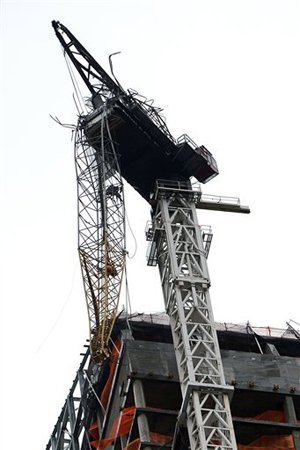
Wrapping up: One57 Crane Mishap, October 2012

In the next couple of months I'll be linking to final reports (if issued) on accidents, mishaps, and disasters mentioned in Disaster-Wise since I started the blog more than three years ago.

Incident: Jib on Favelle Favco M440 crane flipped backwards over the operator's cab during Superstorm Sandy's high winds. I blogged about the One57 crane emergency, most recently here.

Location: A thousand feet above street level, at the construction site of the One57 skyscraper, in midtown Manhattan (photo, AP Wideworld).

Effects: No one was injured, but the need to secure the area blocked access to nearby buildings and tied up traffic for a week.

Final report: None released to the public yet, and given the safe resolution in removing the danger, we probably won't see one on the NYC Department of Buildings website.

Probable cause: Wind caught the jib while it was upwind of the mast, and flipped the big steel frame over the cab. We're told that the crane's controls were set so it would "weather-vane" in the wind, meaning it would pivot so that the jib would always be downwind, but severe turbulence around the building might have neutralized that precaution.