Comments about technological history, system fractures, and human resilience from James R. Chiles, the author of Inviting Disaster: Lessons from the Edge of Technology (HarperBusiness 2001; paperback 2002) and The God Machine: From Boomerangs to Black Hawks, the Story of the Helicopter (Random House, 2007, paperback 2008)

Friday, September 21, 2012

Deep Wrecks: The Battle of Leyte Gulf, 1944

We're coming up on the six-month point following the solo deep-dive of Deepsea Challenger. James Cameron is immersed in movies again and his green submarine has thoroughly vanished from the newsfeeds, presumably to resurface as a 3D movie in late 2012, accompanied by an article about the Mariana Trench in National Geographic. But the adventure must have been fun while it lasted. Along the way I posted info-graphics like this:
Skeptics wondered if anything was behind the big splash in late March other than Cameron's desire to set a solo record and facilitate certain movies, but oceanographic experts were part of the expedition and the Deepsea Challenge project should produce some worthwhile science. I predict most of the value will come from work by the two unmanned landers rather than the manned sub, because the landers could stay down for long periods.

This sidebar question came up among the many articles that dutifully relayed Cameron news that month: What's the deepest shipwreck? Sir Richard Branson said in an interview with the Christian Science Monitor that the oceans has thousands of unexplored wrecks, including galleons: "Magnificent exploration potential," said he.

So that made me wonder what the deepest wreck might be that's still ripe for discovery. I checked with salvage sources and while the question can't be answered with any certainty given the early state of hadal-zone exploration, it's possible to come with a short list of candidates.

Here's my nominee: a Japanese submarine sunk during a battle offshore of Samar Island in October 1944, which was a center of action during the Battle of Leyte Gulf. 

US Navy records indicate that the destroyer escort Richard M. Rowell sunk a Japanese submarine with depth charges on October 24 at 09 d. 45'N., 126 d. 45'E. For some years war historians reckoned this casualty as I-362, but according to more recent postings on Wrecksite.eu it was I-54, which looked like this:
The sub went down over the Philippine Trench:
That's just west of the Emden Deep's lowest point. This from NOAA's multibeam-sonar bathymetry page:

Other warships hit during the Battle Off Samar could have glided into places as deep that day, but from the battle reports available, I'd vote for I-54 as one of the deepest shipwrecks anywhere, coming to rest at 25,000 to 30,000 feet.

So if Sir R.B. still has lots of money to spend, and if he still wants to go face to face with a hulk never ravaged by treasure-hunters, the Emden Deep would be a good place for Virgin Oceanic to visit.

Saturday, September 8, 2012

A Vortex in Vegas: Advanced fire protection

Last month I was in Las Vegas attending the AUVSI unmanned-vehicle trade show to research an article. While there, I stayed at the Luxor Hotel. It's a pyramid-shaped building with hundreds of rooms arrayed around a cavernous atrium. From the outside, it looks like this:
Those who have walked around the atrium might recall this part of the ground floor near the hotel registration desk and escalator to the theater level. 
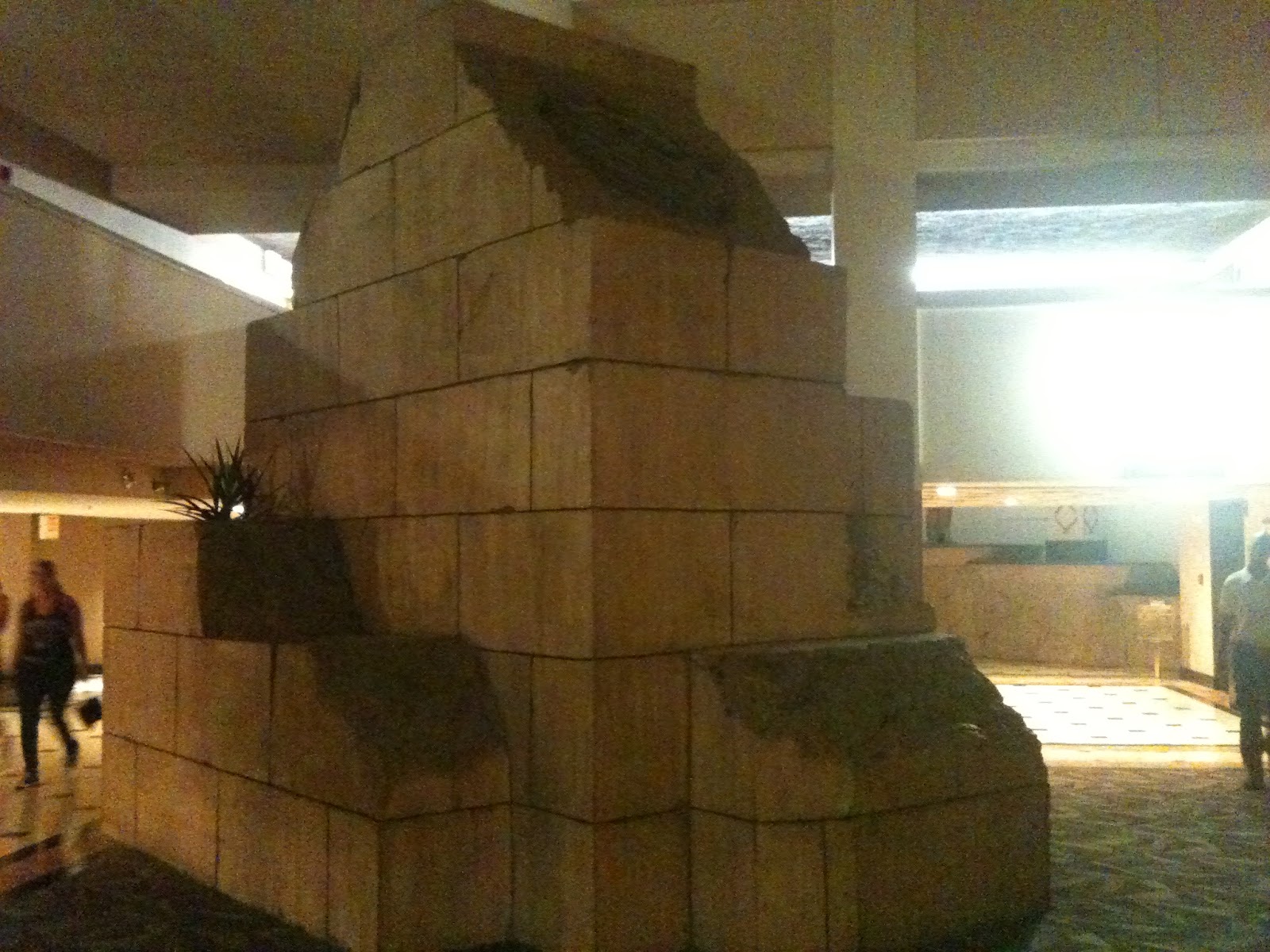
Tucked into this scene is a slightly odd structure, about twelve feet high. It looks like a stack of leftover blocks from the Egyptians' last pyramid. 

Here's a closer view. Can you guess why it's there?

Here's another view:
Why would faux limestone blocks have a big hole in a slanted face? Because it's the exhaust port for a very powerful fan. There are eight of them around the base of the atrium (diagram from Fire Protection Engineering, Summer 2000).
Together with other gear (such as smoke-detecting light beams emanating from the obelisk) the "vortex fans" are critical to controlling the movement of smoke in case of fire. 

(That's important because smoke is the principal hazard in most fires, as we know from disasters like the MGM Grand fire in Las Vegas. In that 1980 fire, out of 84 people who died, 82 succumbed to fumes and smoke, rather than flame.)

 Clark County's building department wouldn't have allowed the Luxor Hotel to open without the special arrangements, because standard smoke-handling methods wouldn't work for a giant atrium.

In a traditional building like an office building or an older hotel, each level can be pretty well isolated by careful attention to stairway doors, floor decks, and seals in elevator-lobby doorways. That makes smoke control straightforward: if the barriers hold, smoke can't rise from the fire floor to threaten people on floors above.

The situation is more challenging in tall buildings with cavernous atrium spaces. These have no barriers to smoke movement, so heated smoke can rise, cool and form a toxic, stagnant layer at the top of the space. Why not just install whopping big fans at the apex? It wouldn't be enough to protect guests in the upper levels because a dangerous smoke layer could still form and spread sideways into the rooms. Just raising the apex-fan horsepower would create hazards of its own. 

The solution proposed was this: eight high-capacity fans around the base of the atrium, aimed upward and diagonally, would set the atrium air moving in a vortex. That would confine the smoke into a spiraling column, keeping it away from the floors as it rose toward exhaust fans in the apex.

Clark County wanted a test to verify the computer model, so the hotel owners brought in Hollywood-type smoke generators and gas-fired space heaters to simulate hot smoke from a fire in the base of the atrium.

I'm told the smoke test at the Luxor worked well, with the fans keeping the smoke out of rooms in the upper floors. And kudos to whomever insisted on verifying the model results with a field test! I put little faith in computer models that aren't tested, and retested, against the real world.

Saturday, August 4, 2012

Macro on a Budget: Eye of the dragonfly

Last weekend we saw this estimable creature clinging to our mini-vineyard:

It's a common green darner dragonfly, the Washington State Insect. Its top speed on the straightaway is at least 30 mph and some persistent person determined that one could fly 85 miles in a single day. I checked the leaf later with a ruler, and it must have stretched four inches from nose to tail.

Using a macro setup, I crept as close as I could and snapped its portrait:
Normally bugs don't let me get this close, but maybe its size gave confidence. Here are facets on its eye:

My DIY style of macro photography (relying on used equipment bought via eBay) requires many trials to get satisfactory lighting and focus, but with a digital camera, that's no obstacle.


Monday, July 30, 2012

Big Bay Bang: In a Long Line of Accidental Pyrotechnics

As a writer in history and technology I try to group current events with some class of earlier, comparable mishaps. In this case the class is the "inadvertent and instantaneous firing of multiple pyrotechnics."

On the evening of July 4, a half million fireworks-fans were treated to a spectacular show over San Diego Bay, all five locations (four barges and a pier) launching their entire arsenal of 7,000 pyrotechnics in a few seconds, rather than 15 minutes (Photo Ben Baller, AP):
Each pyro device (typically launched out of a short, vertical mortar tube) is ignited from a central control. The control closes circuits according to a programmed chronology, sending an electrical charge to an electric match that produces a brief flame inside a lifting charge. One variety of the electric match is the nichrome wire that my brothers and I used as kids, when launching our Estes rockets.

The contractor, Garden State Fireworks, later released a three-page, not particularly instructive, paper that lays blame on the interaction between a primary and backup computer program. Many details are left unexplained, but we can gather that a typical Big Bang show is commanded over a continuous radio link transmitted from a central point, because the five launching locations are scattered across 14 miles of harbor. 

The local firing computer on each barge was to have on hand a stored ignition sequence so that it could continue running its part of the choreographed show, in case the radio link were broken.

The show's radio-command link was supposed to start running five minutes before the first launch, so that operators stationed at each local computer could verify that all systems were nominal. And the radio transmission did begin at this time. Normally the program runs "in the dark," meaning that even though the sequence has begun, there's no visible result except on computer displays.

Not this time. Garden State's mea culpa paper says that the backup program somehow got crossways with the main program, and the combination immediately instructed each computer to send firing signals to all the electric matches at once, somehow deleting the planned interval. 

So this year's aptly-titled Big Bay Boom show started five minutes ahead of schedule and ended soon thereafter. Despite the early start and the intensity of the fusillade, we're told that none of the fireworkers were injured, having sought out armored shelters nearby. We can hope that they were all wearing hearing protection at the time. 

Reading about this reminded me of an earlier but more sobering simul-blast, 53 years earlier, also in early July. The location was Chennault AFB in Louisiana, where a B-47E StratoJet bomber, No. 53-4212, was being prepared to join other planes already on the flight line. All were to be ready for a quick takeoff in case of nuclear war. 

Date: July 6, 1959. A single H-bomb (probably a Mark-15) was on board and No. 4212 was fully fueled. Attached to the rear of the fuselage were dozens of solid-fueled takeoff-assist rockets, often abbreviated JATO bottles. Each would provide a thousand pounds of thrust upon ignition. Here's a B-47 photo that will give an idea of the JATO bottles' placement on the underside.
Here's an old movie of a B-47 taking off with the help of JATOs:
As the B-47's pilot stood on the ladder giving directions, somehow an airman's electrical checks ignited the entire rack of 30 JATO bottles. (I am guessing the root cause can be traced to a continuity check to verify the bridgewires, but if so, something went terribly wrong because a proper continuity-checking device uses voltages far below the energy needed for ignition.)

All 30 rockets belching flame and smoke, the 100-ton airplane lumbered over its chocks and accelerated toward the flight line. A wing broke off, spilling fuel. The navigator jumped out, his clothes on fire, but survived. The pilot tried to jump free but was killed when the airplane rolled over him. After a few hundred feet the plane lurched off the pavement and crashed in a fireball.

It was a lot scarier than the usual one-sentence mention to be found in the history of the weapons program, revealing no more than a "ground fire in a B-47 at Chennault AFB consumed one nuclear weapon." So scary, in fact, that some base workers heard the emergency sirens, saw the flames, jumped in their cars, and didn't slow down till they crossed the Texas border. 

JATO demonstrations are still a highlight at many military air shows, pushing C-130s into steep climbouts. A large number of JATOs figured in a daring plan to land a C-130 in a Tehran stadium during the Iranian hostage crisis, and take off again. But the prototype crashed in tests and the entire rescue plan fell through for other reasons.

Monday, July 23, 2012

Oceans of Mystery: Another newly discovered seamount

In this January 2011 post I described a North Pacific seamount discovered in 1950 by the research ship Cobb. In waters thought to be two miles deep, Cobb's sonar detected the tip of an undersea mountain that reached to 110 feet of the surface. Here's a map from a Popular Mechanics showing the location:
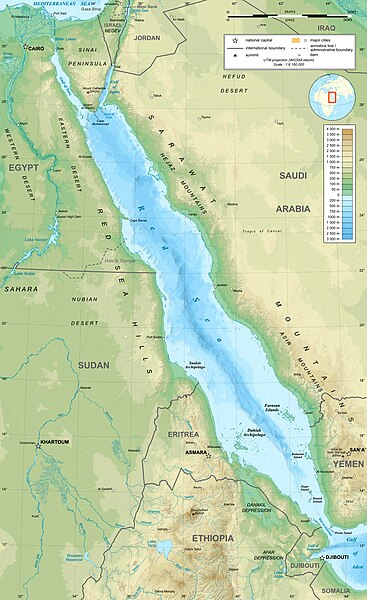
Now we have similar news from the HMS Echo: during explorations of the Red Sea last year, that Royal Navy survey ship found an unmapped seamount rising to 131 feet of the surface, in waters shown on charts as more than 1,200 feet deep. Here's a depth chart of the Red Sea:
Here's a depth-coded sonar image of the newly christened seamount:
Some Red Sea fishermen knew about the Gibraltar-sized pinnacle (since they used the peak as a holding ground for their anchors) but not the mappers.

While no ship draws 131 feet of water (the record holder is Seawise Giant, an ultra-large oil tanker that drew 80 feet of water) the seamount would pose a hazard for submarines. 

In the previous post, I described how the nuclear submarine Pogy (SSN-647) ran into an uncharted Pacific seamount in 1972. The sailors survived that high-speed collision, but the boat took major damage.

Wednesday, July 18, 2012

A Traveler's Tale, Part 3: The Root-Cause Conclusion


Part 1 and Part 2: Rick Asplundh plans an easy test of the company's time machine at the request of the R&D Division chief, intending to go back in time just a few minutes and then return. But the uncalibrated machine goes back much further, dropping him into the Black Hills outside Deadwood, Dakota Territory. And the “return to home” button doesn't work either. 

Asplundh waits by the stranded machine, then goes into town to find work. He takes a job at a gold mine tending mules underground, and quickly learns that the underground workings are deep in crisis: Earlier that month, something very odd started afflicting the mules and the mining gear too, reducing daily tonnage, and then ore quality. Seeing the miners spiral into despair, Asplundh realizes he has a skill nobody in 1877 has: training in root cause analysis! 

Co-opting the Acme mine's baseball team to serve as fellow investigators, Rick uses all the tools in the root-cause-analysis toolbox to narrow the huge initial brainstormed list of possible causes. He feels he is closing in on the chain of events until one fateful day, when the Acme mine's management decides that he has been planning to sabotage the operations for a rival owner.

Now, Part 3 of the memo from our hero to his far-away boss, “A Traveler's Tale.”

                         ~  ~  ~  ~  ~  ~ ~  ~

THIRD MEMO
From: Richard C. Asplundh, Staff Engineer, Rapid Prototyping Div.
To: Boss
Re: Mixed Results with Prototype X-1A Time Machine, Continued
Date: September 8, 1877
Via: Sulphur Springs Tonic Water


As you recall, I was in hot water earlier this week because I had my baseball team work up an Anticipatory Failure Determination. (Note to self: I should have gotten the mine bosses on board with AFD first, which is a powerful tool but one that can sound pretty strange to a stranger.)

As you know, AFD asks experts to brainstorm how they'd make sure that some specific and catastrophic problem comes about.

I'm summoned to the mine's front office and accused of planning to sabotage the mine. Why? Because I had asked the company baseball team (doubling as my informal root-cause team) to work out answers to the following question, while hewing to the principles of AFD: “If you wanted to guarantee that the miners in Acme's 'Queen of the North' payzone go after the worst ore possible -- ore so bad that it would crash the whole Acme business -- how could you be sure they do it wrong every time, day after day?”

By turning the tables on the usual prevention-oriented questions, AFD has a way of prying out new and creative thinking on cause and effect. It can be very useful when departments are on the defensive and no longer contributing.

So the mine bosses prepare to wring out a confession. I'm guessing they think I've been sent from a rival mine to ruin their business, so the enemy can buy it for a song.

Time to show my cards. “Let's think this out first," I say, displaying a steely-eyed confidence I don't yet feel. I point to the calendar on the wall. "The problem started two weeks before I even landed here,” I say, "so I didn't have anything to do with it. Yep, yep, it was an odd question and I should have cleared it with you gentlemen first, but it was just my way of confirming what's really wrong with the mine's bottom line. What's more, we found the root cause! A few simple steps, and the Acme Mine's problem is solved!”

That brightens them up enough to let me pace the floor while I talk. The superintendent had been fingering a length of rope, perhaps planning to make a hangman's knot, but he sets it down. No noose is good noose!  

Cautionary note: at this point I actually haven't nailed down all the details, but it's no time to dither. I figure that just talking through the facts one more time will make the picture clearer. So I take a deep breath and reach over for the long roll of butcher paper holding my team's last two weeks of work, including the Current Reality Tree. It's damned impressive – it'd run across the street and into the saloon if I rolled it all out.

I point to a date in the timeline. "Your problem started when the Health & Safety person, Yosemite Jack, decided to get rid of the mine-rats by starving them out,” I say. “It had some unintended consequences. On or about July 28 Jack ordered the miners to stop feeding the rats the scraps from their buckets when on lunch break in the mine. The men weren't so sure about this, but they decided to go along. The rats got hungry and hungrier. What to do? Our furry little friends started nibbling on the leather steam hoses.

"The steam leaks got worse and worse, so the steam drills didn't work like before. The daily tonnage went down just a little, day by day. Look at this line right here, the first week of August,” and I jabbed at the chart. “That's from the Queen of the North payzone. The problem starts to really hit home on August 8, when some goofball spills a big pail of lard on eight crates of dynamite sitting in the sun, before it's taken down the hoist for storage in the mine. How did that happen?”

“The lard was to grease the axles on the mine cars,” says a shift boss, “and I guess somebody from the Supply Department knocked the keg over when horsing around. It got hot, the bung comes loose, it dripped out.”

“Aha! From little acorns, great oaks grow! Nobody thinks to clean the lard off and two hundred pounds of yummy dynamite go down to the bottom of the mine for storage in the powder magazine. The rats sniff out the lard, like icing on a cake. Unfed, unloved, they start dragging sticks of dynamite off to nibble them later. They hide them … where?” I point to a diagram of the mine. My finger starts at the powder magazine and slides over to the underground mule stable, a few hundred feet down a side tunnel.

Too-Tall Johnson offers: “In the mule feed?”

“Exactly! Rats live in hay because it's warm. Rats are always hiding food and they hide some in the hay for future meals. The mules come along and munch them up along with the hay and it gives the mules a bad headache. Worse: one mule bites down a little too hard, and away it goes. Now we have sick mules with headaches, we've got superstitious miners, we've got an unexplained explosion in the stable, we've got leaky steam hoses, we've got drills that underperform, and we've got a dynamite shortage. 

"So why does this go on? Nobody puts the pieces together, and some of the pieces are trouble to even talk about. We root-cause people see this all the time: the facts are there but nobody puts them together.

"Take the powder monkeys. They don't say anything because they know they're short on the dynamite count, and they don't want to let management know that somehow they're a couple of cases short. Nobody wants to speak up - they might get accused of stealing dynamite for some gang of highwaymen, or for some cheapskate mine wanting to cut its costs. What to do? They can hold back on how much dynamite they put into the holes before blasting. That seems to make sense because the holes aren't so deep as before, what with the drills losing power from leaky steam hoses.

"So now neither the drills nor dynamite are working like they did before, and the daily tonnage really starts to fall off the cliff. Look at this line on the chart here, when you managers order them to bring the tonnage back up, or else. What's the only way to bring the tonnage up?” I point to my Anticipatory Failure Diagram.

The bookkeeper speaks up. “They could have tried to fake the scalehouse numbers, but that's double-checked at the stamp mill and outside our containment zone.” He stands up to read better, “… Or they could start blasting out crumbly ore that's weak and easy to break out, whatever the assay! That would bring the tonnage up, but at the cost of quality.”

“Exactly! Each department tried to paper over their own problem, just enough to stay out of trouble. So we get the Undesirable Effects box, listed right here at the top of the Current Reality Tree: First a big drop in tonnage, then a drop in assayed ore quality. The men in the Queen of the North payzone went after low-quality quartz that's all rotten and fractured. The mining engineer was out all this time with broken bones so he couldn't get around to see what was going on. 

"He wasn't a root cause of the problem, but when he fell down the shaft and got laid up, he opened the way for the little causes to join up. So: we talked about sick mules, exploding hay, an injured engineer, leaky steam hoses, and bad cases of Giant Powder. None of these were a root cause, but they opened the way for the mine rats to cause havoc with your business plan. I'd have to admit that it's the first Rat Cause Analysis I've ever worked on.”

So that's the story, boss! They gave me a rousing cheer. Better yet, they approved a project budget and appointed two action teams, one aboveground and one underground. Next day the Acme Mine got rid of all the greasy dynamite, they cleaned out the explosive hay in the mule stable, they smoked a peace-pipe with the mine rats, they brought in a temporary mining engineer, and they bought new steam hoses and drill bits. Acme is back up and hitting the numbers on tonnage and quality too. Now we'll see if they remember my closing suggestion: weekly followup for the next two months, then monthly through the end of Fiscal 1878. The landscape is littered with great action plans that fell apart because nobody in authority followed up.

Speaking of the next two months, I'm still stuck here in 1877, but I'm going to try a little Bayesian inference to troubleshoot my misbehaving time machine. I'll need a lot more data to plot, though, so that means more trial runs of the X-1A. 

So keep me on the payroll, and stay alert for more messages! My memos might come packaged up in anything from a Sumerian clay pot to a force-field bottle.

Monday, July 16, 2012

Train collision in Oklahoma: Jump or die


I mentioned in this post, Unstoppable and the Story of CSX 8888, that railroad companies don't permit engineers to leap from a moving train except in cases of imminent collision. This may have struck some as a quaint but unlikely scenario, a reference to engineer Casey Jones' last words to his fireman: "Jump, Sim, Jump!" 


But it still happens. A recent incident came with the June 13 collision of two Union Pacific freight trains near Goodwell, Oklahoma. (Photo: Trudy Hart, Guymon Daily Herald)
Each head-end engine (the locomotive in front) had two crewmen, for a total of four lives at risk.

How could two dispatched trains smash into each other in mid-morning on a straight, flat stretch of track? So far there's no explanation why the westbound train didn't get to its assigned siding in time, though railfans have plenty of speculations. 

We have only the bare facts from the NTSB preliminary statement: speed of each train, total weight (about 12,000 tons), the weather (clear and hot), and the trains' location on a main line in the UP's Pratt Subdivision. But an explanation will be forthcoming: for one, there's recorded data. While the collision destroyed black-box recorders in the lead engines, each train had a locomotive at the rear with its own event recorder, and the UP's traffic computers should have a record of what happened when.

And there's a survivor to interview. While three crewmembers died in the crash and flames, a fourth jumped from the slower of the two trains and tumbled to a stop with minor injuries. 

Knowing when to stay or go is a key part of what I call the Survivability Zone -- more on that later.